

Two individuals have been apprehended in connection to the high-profile robbery at the Louvre Museum in France, during which eight valuable crown jewels were stolen. One of the suspects was captured at Paris Charles de Gaulle Airport while attempting to board a flight days after the robbery, in which a gang escaped with jewelry worth £76 million. The suspects were tracked down based on forensic evidence linking them to the crime scene at the Louvre. Following the heist, authorities typically monitor suspects in the hope of recovering the stolen items. However, immediate arrests were made when one of the suspects was spotted at the airport. The suspects are currently being interrogated at the Paris judicial police headquarters.
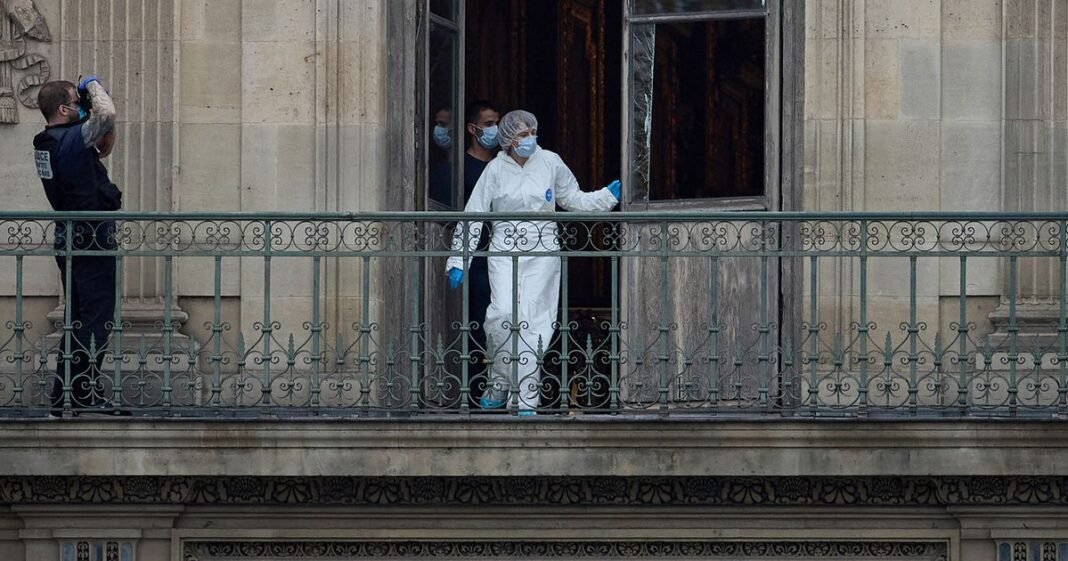
The Louvre went into lockdown following the incident, where the gang, disguised in high-visibility vests, used a mechanical ladder to access a first-floor balcony. They then broke into the Galerie d’Apollon through a window using power tools before fleeing on scooters. The stolen jewelry included a brooch adorned with 2348 diamonds and a tiara embellished with 1083 diamonds, previously owned by Napoléon Bonaparte’s relatives. During their escape, the thieves dropped a headpiece created for Empress Eugénie, sustaining significant damage that will necessitate extensive restoration work.
President Emmanuel Macron has vowed to capture the culprits and recover the stolen items as a widespread manhunt is underway. The recent arrests follow the discovery of over 150 DNA traces, including fingerprints, left behind by the burglars. Forensic teams are analyzing the samples to identify the perpetrators quickly. Authorities are optimistic about locating the thieves, especially if they have prior criminal records that are logged in police databases. The DNA traces were found on a stolen truck, as well as on a helmet and glove abandoned at the crime scene.
The Louvre, known as the world’s most visited museum, attracts millions of tourists annually. The theft of historical artifacts is often linked to underground dealers who struggle to sell them on the black market. Notably, the museum has experienced security breaches in the past, including the infamous 1911 incident when the Mona Lisa was stolen and later recovered. The painting is now displayed behind bulletproof glass. Another notable theft in 1998 involved Le Chemin de Sevres by Camille Corot, which remains missing, prompting enhanced security measures at the museum.