
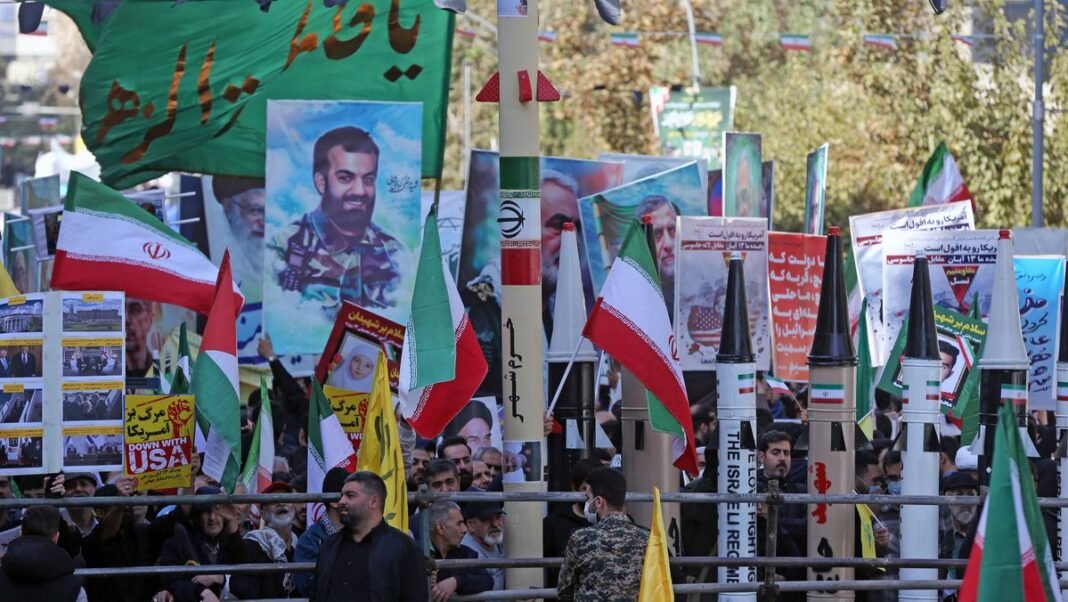

Iranian rebels are optimistic about the potential for democracy to emerge following the collapse of Tehran’s regime. In the 1950s, Prime Minister Mohammad Mosaddegh aimed to introduce constitutional reforms that would limit the Shah’s power. However, a coup in 1953 restored the Shah to power, leading to ongoing instability in the Middle East centered around Tehran, where the powerful Islamic Revolutionary Guards Corps continuously seeks to expand its influence.
Since 1979, the Shia regime has significantly bolstered its military capabilities, extending its reach from Tehran through Iraq, Syria, and into Lebanon. Hezbollah, a well-funded proxy force, has long posed a threat to Israel, while Houthi rebel fighters in Yemen have also targeted Israel and its allies.
Recent conflicts, such as the Gaza war, have resulted in casualties among Hezbollah fighters, weakening the once-dominant network. With economic sanctions impacting Iran’s hegemony in the region, the regime faces increasing challenges.
The Hamas attack on southern Israel, supported by Iranian funding, has further strained Iran’s resources and influence, leading to a significant setback. Additionally, US airstrikes targeting Iran’s nuclear ambitions have further destabilized the regime, increasing the likelihood of an uprising.
The potential collapse of the Tehran regime could have far-reaching consequences, including civil unrest, the rise of new power structures, or the emergence of a free society. Key to this transition would be persuading senior IRGC officers to defect, a move reminiscent of Syria’s descent into violence following its uprising.
If the Tehran regime falls, Iran could face internal strife similar to post-2011 Syria or Iraq, leading to mass displacement and a refugee crisis. The possibility of an Islamic State resurgence in a power vacuum remains a concern, highlighting the need for a stable transition or defection within the IRGC to pave the way for a more democratic future.
The fate of Iran rests on the ability to navigate these challenges, with the support of neighboring countries crucial for stabilizing the region post-regime change. The desire for a peaceful transition is growing within Iranian society, offering hope for a more stable and democratic future for the country.