
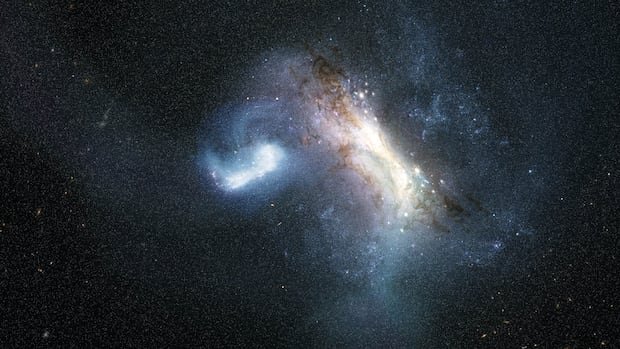

New research has shed light on the complex history of the Milky Way galaxy, our cosmic home hosting billions of stars, including our sun. Scientists studying star clusters near the galactic center have uncovered evidence of a significant event that took place around 11.8 billion years ago when the universe was still in its infancy. This event marks the earliest-known galactic merger for the Milky Way, highlighting its growth through the absorption of smaller galaxies drawn in by its gravitational force.
The merging galaxy, classified as a dwarf galaxy due to its smaller size compared to the Milky Way, was estimated to contain stars equivalent to 500 million times the mass of our sun at the time of the merger, representing a quarter of the Milky Way’s size then. By analyzing stellar clusters within the innermost 20,000 light-years of the Milky Way using the Hubble and Gaia telescopes, researchers determined the age, chemical composition, and trajectory of these stars, which became part of the Milky Way after the merger that occurred approximately two billion years after the Big Bang.
Referred to as Low-energy-Kraken-Heracles (LKH), the dwarf galaxy of origin was identified through previous studies exploring the possibility of such a galactic fusion. According to astrophysicist Davide Massari, the lead author of the study published in Nature Astronomy, this research marks the first merger event experienced by the Milky Way in its early stages, providing valuable insights into its formation.
The study suggests that the Milky Way’s early development was influenced by a peaceful merger, where the influx of stars and interstellar gas from the merging galaxy fueled star formation and contributed to the presence of dark matter. While star-to-star collisions were minimal, the interaction of gases triggered a burst of star formation. The Milky Way has also been involved in two other significant galactic mergers, including the absorption of the Gaia-Sausage-Enceladus dwarf galaxy and the ongoing merging process with the Sagittarius dwarf galaxy over the past six billion years.
Each of these mergers has played a role in shaping the Milky Way and, consequently, our solar system’s formation, highlighting the significance of understanding the galaxy’s past in answering fundamental questions about our origins.