
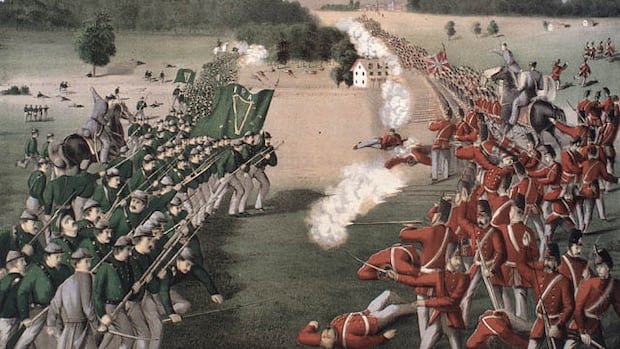

An overlooked conflict that occurred on Canadian land just before Confederation might not resonate widely with Canadians beyond Fort Erie, Ontario, but it holds significant historical value. The Battle of Ridgeway, also known as Limestone Ridge, in 1866 marked the first instance of Canadian forces led by Canadian commanders engaging in combat. This event also inspired Decoration Day, a precursor to Remembrance Day observed in certain regions annually. Despite these historical connections, the names of the nine individuals who perished in the battle are absent from the Books of Remembrance, a compilation at Parliament Hill honoring soldiers who sacrificed their lives for Canada.
A fresh petition, slated for submission in the House of Commons, aims to include the nine fallen soldiers and numerous others who lost their lives in the aftermath of the battle in the official remembrance list. Conservative MP Fred Davies, spearheading the petition, emphasized the importance of acknowledging those who made the ultimate sacrifice to defend Canada.
The region Davies represents, Niagara South, encompasses Fort Erie, the site of the battle. Davies expressed his personal attachment to the area, driving by Limestone Ridge frequently and feeling compelled to ensure national recognition for its historical significance.
The Battle of Ridgeway was not a definitive triumph for the Canadians. Inexperienced volunteers confronted Fenian raiders, many of whom were veterans of the American Civil War. The Fenian Brotherhood, an Irish American group advocating for Irish independence, attempted to seize parts of British North America to leverage for Irish autonomy. In 1866, hundreds of raiders crossed the Niagara River with intentions to target the Welland Canal, encountering approximately 800 Canadian volunteers from various regiments at Limestone Ridge near Ridgeway and Fort Erie.
Historian Peter Vronsky, author of “Ridgeway: The American Fenian Invasion And The 1866 Battle That Made Canada,” commended the rapid mobilization of Canadians from the Golden Horseshoe region. However, he noted that the Canadian troops were ill-equipped for what he described as Canada’s inaugural modern battle, lacking essentials like food, water, proper footwear, and ammunition.
Despite engaging the invaders in combat, the Canadian forces eventually dispersed during a disorderly retreat after a Fenian bayonet assault. Nonetheless, the Fenians withdrew from their incursion post-battle, retreating back to the U.S. side of the Niagara River. Davies emphasized that the defeat on the battlefield does not diminish the bravery and sacrifice of those who perished defending Canada against the invaders.
A memorial commemorating the nine fallen soldiers from Ridgeway was erected in 2016 on the battle’s 150th anniversary. Fort Erie Mayor Wayne Redekop highlighted the town’s prolonged efforts to have the soldiers’ names included in the Books of Remembrance, underscoring their vital role in shaping Canada’s history.
Even though the battle predates the formal establishment of Canada, the Books of Remembrance honor soldiers who perished before Confederation, such as those from the War of 1812. Redekop, Davies, and Vronsky all suggested that the Battle of Ridgeway had a direct influence on the Confederation process, uniting and galvanizing individuals towards the common goal of nationhood.
Several regiments that participated in the 1866 battle, including the Queen’s Own Rifles and the Royal Hamilton Light Infantry, continue their legacy to this day. Vronsky remarked that the battle served as a pivotal moment in modernizing and testing Canada’s armed forces.
Alexander Muir, renowned for composing “The Maple Leaf Forever,” fought in the Battle of Ridgeway and drew inspiration for the patriotic ballad from a silver maple tree in Toronto’s Leslieville neighborhood. Vronsky proposed that Muir’s inspiration might have stemmed from the maple leaf symbol in the Queen’s Own Rifles insignia, the regiment he fought alongside during the battle. This event marked a significant shift where Canadians fought for their local community first and allegiance to the crown second.