
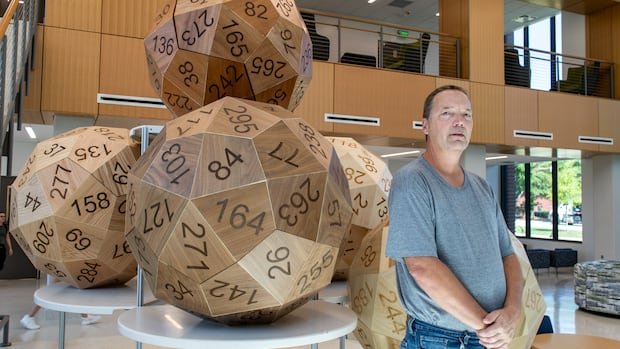

In a gaming convention dinner discussion back in 2012, a board game designer challenged mathematician Eric Harshbarger to create a unique set of dice that could determine the starting player without the risk of a tie, aiming to expedite the game setup process. Harshbarger, a senior lecturer at Auburn University and a mathematician, enthusiastically embraced the challenge, drawn to the non-trivial nature of the problem.
After years of dedication and collaboration with a diverse group of computer scientists and mathematicians worldwide, Harshbarger and his team successfully devised a set of four 12-sided dice capable of producing a fair outcome for two, three, or four players. However, creating a solution for five players proved to be a more intricate task.
The team explored various avenues and gradually narrowed down the possibilities, eventually landing on a practical resolution proposed by a researcher from Australia involving five 120-sided dice. Subsequently, a Canadian software engineer, Paul Meyer, joined the effort and presented a breakthrough solution utilizing five 60-sided dice.
Meyer’s approach involved leveraging mathematical patterns and conducting an extensive computer search to crack the code, resulting in the development of golf ball-sized dice that are now commercially available. Despite some skepticism from researchers regarding the practical application of the dice, Harshbarger remains confident in their mathematical integrity, attributing any imperfections to the manufacturing process rather than the underlying principles.
Looking ahead, the research team, now including Meyer, continues to delve into potential refinements such as exploring the feasibility of fewer sides for a five-player set and the potential expansion to accommodate six players. While acknowledging the current limitations of their mathematical and computational tools, Harshbarger emphasizes the dynamic nature of the problem-solving process, welcoming unexpected revelations and fresh perspectives from fellow enthusiasts in the field.