
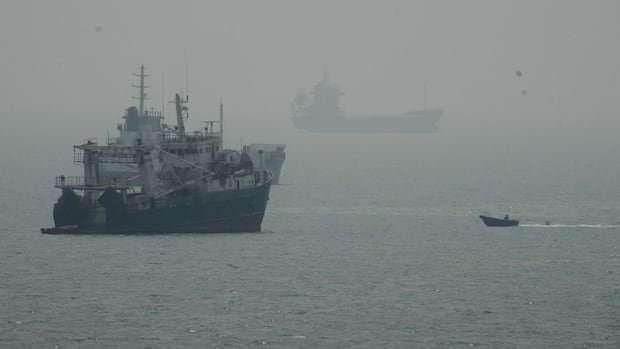

Iran announced on Wednesday that it had carried out strikes on 10 vessels near the Strait of Hormuz in response to the sinking of five Iranian oil tankers by the United States. These attacks marked the most significant exchange of hostilities on shipping between the two sides since the commencement of the ongoing conflict.
The Islamic Revolutionary Guard Corps (IRGC) of Iran reported launching a ballistic missile strike on a U.S. base near Al Azraq in eastern Jordan, targeting two U.S. vessels and eight oil tankers trying to traverse a restricted area in the Strait of Hormuz as designated by Iran. These incidents in and around the critical waterway caused a spike in oil prices, with the international Brent crude benchmark surpassing $100 per barrel for the first time since July.
The escalating conflict between Saudi Arabia and the Iran-aligned Houthis in Yemen has added further instability to energy markets. Recently, the Houthis conducted attacks on four Saudi cities, resulting in significant fires at oil facilities visible from space and causing injuries to 73 people, according to Saudi authorities.
The surge in oil prices has impacted American consumers, with gasoline prices reaching an average of $4.15 per gallon in the U.S., representing a 26% increase from the previous year. Diesel prices also surged, standing at $5.90 per gallon, marking a 59% year-over-year rise.
As tensions persist, the possibility of a comprehensive agreement before the upcoming U.S. midterm elections appears increasingly remote, according to analysts at Bank of America. The conflict has also led to a rise in gas prices across Canada, prompting the federal government to extend the gas tax holiday until the end of January.
Furthermore, Iran disclosed the establishment of a maritime restricted zone stretching from Chabahar in Iran into parts of the Gulf of Oman and the Arabian Sea, with specific coordinates yet to be disclosed. Meanwhile, in Iraqi waters, a drone reportedly struck a tanker carrying two million barrels of Iraqi fuel oil, resulting in a fire on board but no casualties among the crew.
The United Kingdom Maritime Trade Operations agency reported disabling fire incidents on vessels in the northern Gulf and Gulf of Oman during military activities in the region. Iran has also issued threats against oil tankers in Kuwaiti and Bahraini ports, significantly disrupting maritime traffic through the Strait of Hormuz, a key global oil transit route.
In response to Iranian actions, the U.S. military conducted strikes on Iran, citing retaliation for Iran’s alleged preparations to deploy sea mines from rockets in the Strait of Hormuz. The situation remains volatile, with both sides engaging in military actions and threats across the region since the conflict began.
Please note that the original source of this article can be found at the provided link.