
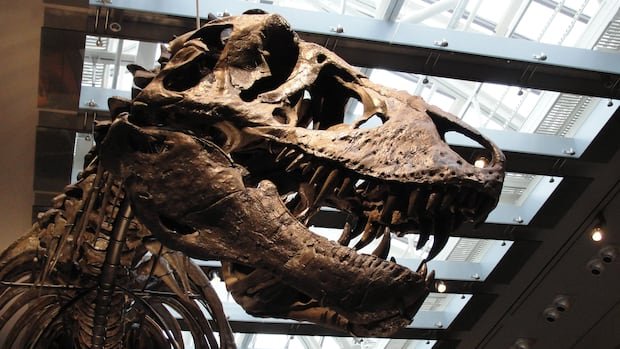

Scientists have debated the warm-bloodedness of dinosaurs for a long time. Recently, researchers have utilized chemistry to gauge the body temperature of two T. rexes. Aradhna Tripati, a professor and geochemist at the University of California, Los Angeles, explained the challenges in this process. The study, published in the journal Science Advances, involved a unique technique that relies on the chemistry of hard tissues like tooth enamel and eggshells to determine temperature variations.
The method involves analyzing the clumping of isotopes in bioapatite, a mineral found in these tissues. By comparing this data with living animals of known body temperatures, scientists can estimate the body temperature of extinct animals, including dinosaurs. A previous study by UCLA scientists a decade ago concluded that titanosaurs and oviraptors were warm-blooded based on eggshell analysis.
To measure the body temperature of a T. rex named Thomas, researchers had to work with tiny samples of tooth enamel due to the thin enamel of tyrannosaurs. By analyzing teeth from the T. rex and another unidentified specimen, scientists estimated the body temperature of T. rex to be between 33.8°C and 38.8°C, similar to large mammals like elephants and flightless birds such as ostriches. These findings suggest that a warm-blooded T. rex could have adapted to diverse environments, including the Arctic.
Paleontologist Anthony Fiorillo, who discovered a small tyrannosaur in Alaska, praised the study for providing compelling evidence regarding the body temperature of predators like T. rex. The research opens up discussions on how dinosaurs, including tyrannosaurs, may have thrived in cold climates. François Therrien, a curator at the Royal Tyrrell Museum, highlighted the importance of precise measurements in understanding the behavior and adaptability of ancient creatures like T. rex. The study sheds light on the metabolic characteristics of T. rex and its potential range across different climates, although debates continue on its metabolism compared to modern warm-blooded animals.