
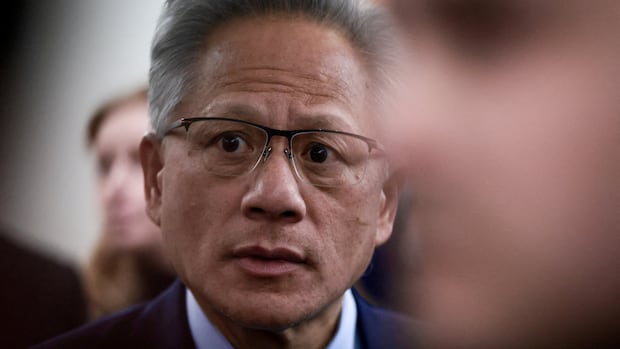

Nvidia’s shares experienced a significant drop on Thursday following the resignation of CEO Jensen Huang amid a high-profile scandal that included allegations of espionage. This unexpected development has left investors pondering the company’s trajectory without its long-standing leader.
After the news broke, the AI chipmaker’s stock plummeted by 14 percent at the market’s opening, in the wake of Huang stepping down both as CEO and board member. However, the shares later rebounded, closing the day down by 4.3 percent.
Despite Nvidia’s turmoil, the wider market appeared to be largely unaffected, with major indices recording only slight declines by the end of the trading session.
Michael Dehal, a senior portfolio manager at Dehal Investment Partners, indicated that the swift appointment of CFO Colette Kress as interim CEO likely contributed to the recovery in Nvidia’s stock.
“The prompt resolution on a temporary basis was comforting to investors,” Dehal remarked.
However, this marks a considerable downturn for a company that achieved a $5 trillion US valuation just a year ago, now having lost over $500 billion US due to Huang’s alleged affair with a suspected Chinese spy, alongside a staggering $1 trillion US decline since its peak in October. While Huang has acknowledged the affair, he has not confirmed whether it was with Alice Huang, who U.S. intelligence claims is linked to Beijing. Reports from the New York Times suggest he may have also had an affair with a company vice president who reports directly to him.
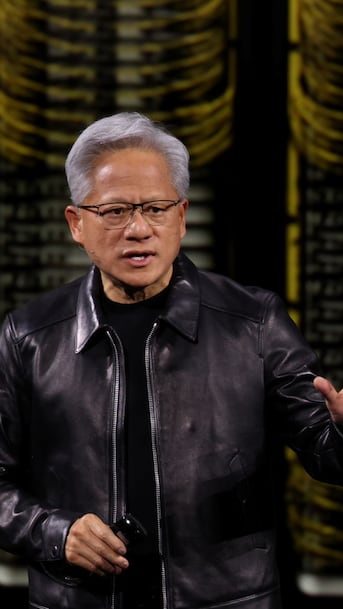
Nvidia, the U.S.-based tech giant, was rocked by allegations that president and CEO Jensen Huang had two extramarital affairs, including one with an alleged Chinese spy. Following his resignation, CFO Colette Kress has stepped in as interim CEO of the world’s dominant chipmaker and AI powerhouse.
CORRECTION (Nov. 12, 2026): This video erroneously shows an image of the Dow Jones Industrial index instead of Nasdaq.
This situation is concerning for industry observers who are reevaluating Nvidia’s value in the absence of its seemingly irreplaceable leader and co-founder.
Financial planners and investment managers warn that such drastic fluctuations can also affect investments and retirement funds for many Canadians.
As one of the most valuable firms globally, Nvidia significantly influences major stock indices, where companies with higher market capitalizations are more heavily weighted.
Given its scale, the Santa Clara-based company constitutes approximately six percent of the S&P 500 and around nine percent of the tech-centric Nasdaq.
Dehal mentions that many Canadians invest in index funds through exchange-traded funds (ETFs) that track these major indices, potentially exposing them to significant fluctuations in Nvidia’s stock value. While mutual funds might also lean toward technology, they could offer greater diversification due to active management by finance professionals.

A screen on the floor of the New York Stock Exchange displays news about Nvidia’s stock price in New York, on Monday. (Yuki Iwamura/Associated Press)
In recent years, technology companies have increasingly dominated these indices, especially as the AI surge has boosted the valuations of firms like Apple, Microsoft, and Alphabet, Google’s parent company. With tech firms now accounting for an estimated 40 percent of the S&P 500, certified financial planner Zainab Williams highlights that investors in basic ETFs may be vulnerable to considerable shifts in tech stocks, particularly in AI.
“Many individuals hold various ETFs and believe they are well diversified,” Williams noted. However, if those ETFs contain a large number of the same companies, “you are exposing yourself to similar types of volatility.”

Portfolio manager Michael Dehal says Huang’s quick exit from Nvidia was ‘reassuring to investors.’ (Submitted by Michael Dehal)
Some analysts express concern that the Nvidia scandal may have broader implications for the tech market due to the company’s pivotal role in advancing AI.
With an estimated 80 percent market share in chips that power everything from AI data centers to ChatGPT and drones, Nvidia is a crucial player in the sector. The company has also invested significantly in supporting other AI enterprises, including backing firms like Anthropic, Toronto-based Cohere, and the cloud service provider CoreWeave.
As Huang was instrumental in facilitating these investment deals, Dehal points out that Nvidia’s continued support for other technology companies remains uncertain, which could temporarily impact other AI businesses.
Nonetheless, he and other investors anticipate that the tech industry will not suffer a severe downturn. In fact, companies like Broadcom and AMD, which manufacture their own chips, saw gains on Thursday, compensating somewhat for Nvidia’s losses, as noted by Jamie Murray, president of Murray Wealth Group.
“The capital is still in play, and spending will continue. We don’t foresee this slowing down the entire sector, but rather a reallocation of resources,” Murray explained.
For those with well-diversified portfolios, Dehal suggests there is little cause for concern, yet he emphasizes the importance of avoiding over-concentration in any single investment.
-
How China gets around the U.S. ban on Nvidia chips
-
Could AI really ‘kill all humans’?
-
Ottawa to invest up to $1.6B in AI company Cohere
Williams suggests that this incident may urge investors to “look under the hood” of their investments to better understand their exposure to specific industries or companies.
“If last week’s developments caused you significant concern, consider steps to mitigate that exposure and explore investments in different countries or sectors,” Williams advised.