

On the morning of Monday, March 2, an incident of assault occurred involving an Edmonton transit user who was traveling through Churchill Station to board the Valley Line LRT.
“They hit me in the face,” the victim conveyed in a text sent later that day to Transit Watch, the safety reporting service for Edmonton Transit Services.
“I didn’t report it immediately because I just wanted to leave and get home,” the individual explained in the message.
On the same day, Transit Watch received multiple reports from riders regarding issues such as harassment, visible drug use, drug sales, a fire ignited at a bus stop, and someone brandishing a lighter inside a transit center.
The City of Edmonton has been making efforts to enhance safety on public transit for several years by increasing the number of peace officers and police, broadening outreach teams, and investing in cleaning and security enhancements.
Nonetheless, messages sent to the safety line over a month earlier this year indicate that many riders still harbor safety concerns regarding the transit system.
CBC News acquired text messages sent to the line from mid-February to mid-March through an Access to Information Act request. The documents, comprising over 200 pages, include incoming reports and the responses from control center staff, showcasing daily reports from various locations across the city.
Drug use remains a primary concern
Numerous reports express worries about drug use and smoking in LRT stations, bus stops, and pedestrian walkways.
“It would be fantastic to have my commute without encountering illegal drugs and dangerously unstable individuals EVERY day,” one rider texted in February after observing drug use in an LRT shelter at the Kingsway/Royal Alex LRT station.
Reports from riders included sightings of individuals using meth, crack, and fentanyl on transit property. One person alleged they were harassed and cursed at for ten minutes on a bus by someone under the influence. Another individual reported that a female passenger, high on drugs, directed antisemitic slurs and hateful remarks towards them for several minutes without any provocation.
“I really want to go inside and warm up at Kingsway Station, but there are numerous people smoking pipes in there, and I don’t feel safe breathing that in,” one rider shared on February 21.
Transit users also reported witnessing drug transactions, discovering drug paraphernalia, and observing individuals urinating, shouting, and obstructing pathways.
One texter recounted reaching into a ticket machine at Davies Transit Centre, only to find a used condom.
“I felt it was important to report this because it poses a safety risk if someone were to reach in there without checking first,” the individual wrote.
Additional messages referred to a pool of blood inside the Belvedere Transit Station, fires started in transit areas, broken glass, someone being shoved on an LRT train, and threats of stabbing at MacEwan LRT station.
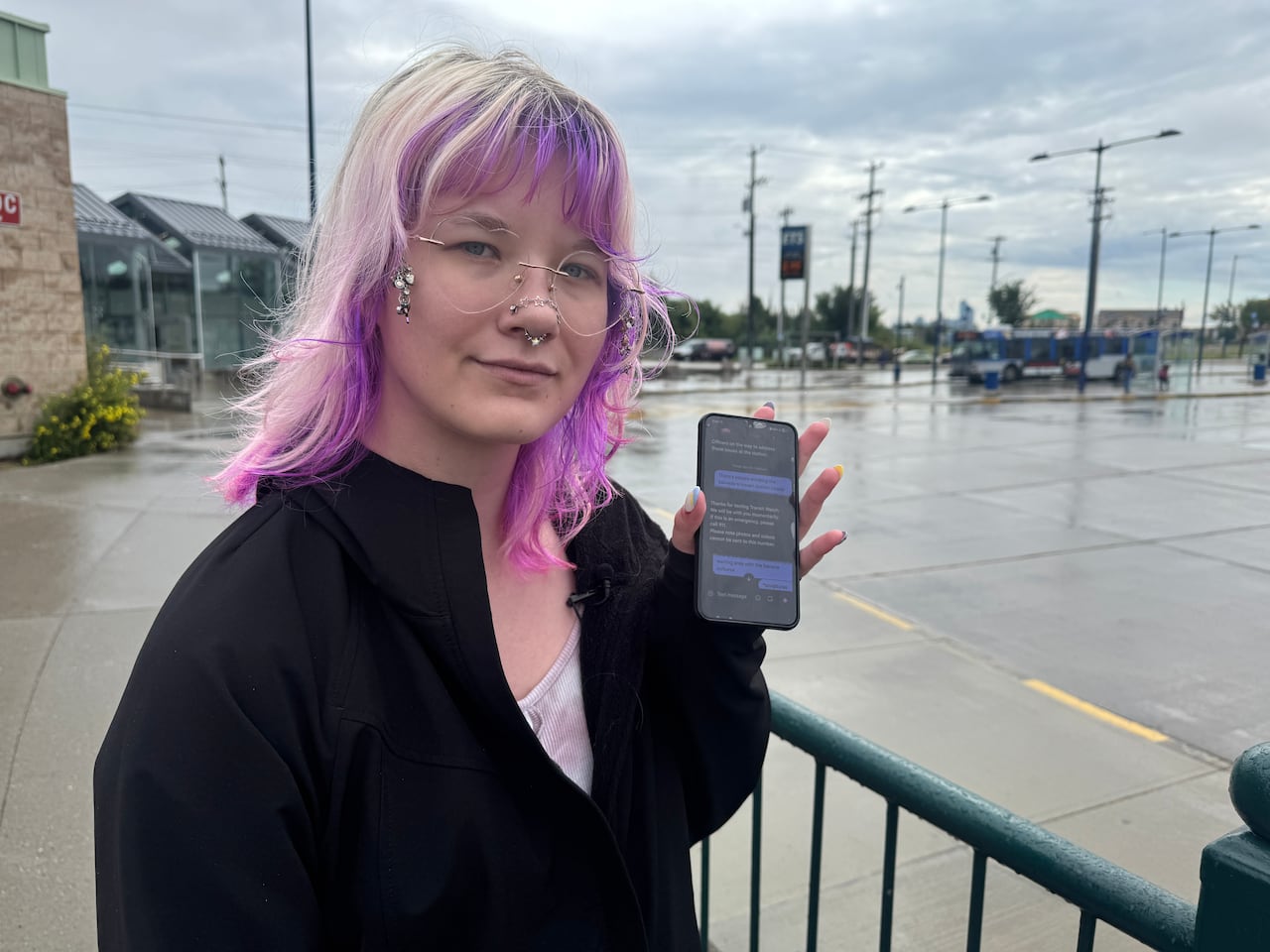
Rider Katarina Hamilton texts Transit Watch about once a month. (Madeleine Cummings/CBC)
Katarina Hamilton, a regular transit user, mentioned that she sends texts to Transit Watch about once a month, frequently observing individuals obstructing entrances and starting fires, particularly during the hours of 8 p.m. to 7 a.m.
On one occasion, approximately a year ago, she witnessed a weapon-involved altercation at Central Station.
Fearing for her safety and that of nearby children, she contacted Transit Watch and subsequently called the police.
“That’s just not an ideal situation to be in,” she remarked.
Hamilton expressed that having more peace officers within the system and an increase in security cameras on buses would enhance her sense of safety while using transit.
Perceptions of safety remain unchanged
Every year, ETS conducts surveys among thousands of riders regarding their safety perceptions. In 2025, 61 percent of transit users reported feeling safe during their most recent trip, which is consistent with the previous year’s data.
In a statement, Carrie Hotton-MacDonald, the branch manager of ETS, noted that various factors influence riders’ safety perceptions, making it challenging to change these views in a short timeframe.
She mentioned that there is an increase in contacts to Transit Watch during the colder months, and that messages to the service have grown year-over-year, alongside rising ridership and awareness about the safety line.
Data from the Edmonton Police Service indicates that police responses to violent incidents at LRT and transit center locations rose from 292 incidents in 2024 to 307 incidents in 2025.
However, calls this year have been lower than those recorded in 2025.
Possibilities for enhancing safety
Hotton-MacDonald stated that ETS is introducing various initiatives to help riders feel more secure while using transit, including the addition of 30 peace officers and the establishment of an eighth community outreach team.
“Other measures being put in place this year that might enhance perceptions of transit safety include providing cell connectivity in LRT tunnels, increasing rider outreach and engagement, offering travel training support to passengers, as well as making improvements to infrastructure at stations,” she outlined in her statement.
Councillor Anne Stevenson from Ward O’Day-Min emphasized that transit safety has been a significant priority for the city council.
She noted that pop-up events organized by the Edmonton Arts Council are contributing to making downtown LRT stations more vibrant, and she expressed her desire to support additional initiatives, such as having safety attendants.
She acknowledged that challenges persist because the underlying causes of social disorder remain unaddressed.
“I am optimistic about the recent announcement by the province regarding an additional $30 million for housing and drug treatment support,” she added.
When discussing overdose issues with CBC News last month, Councillor Jon Morgan expressed the belief that individuals lacking access to housing or addiction treatment often resort to using drugs on public transit for their own safety.
“They find locations where they can use drugs and be visible in case of drug poisonings,” he stated.
David Cooper, the principal of Leading Mobility Consulting, a firm specializing in transit and transportation planning, remarked that cities across North America are facing similar challenges and seeking effective solutions.
Cooper co-authored a study on public transit drug use published last year and compiled a list of transit safety recommendations for Canadian agencies in 2023.
He noted that cities like Edmonton have implemented many of his suggestions, such as hiring more enforcement and outreach personnel, increasing spending on cleaning, and making design changes to stations to deter crime.
“The ongoing challenge is how to engage our provincial and federal partners to do more on this front,” he commented during an interview with CBC News.
While one-time funding announcements for staffing or infrastructure improvements are encouraging, he stressed the need for continuous support.
“This feels like we are pushing a boulder uphill, and if we stop, it will roll back down,” he concluded.
Tag: rewrite-pending