
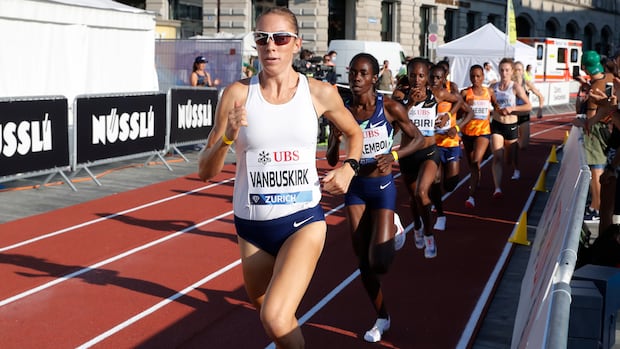

When Kate Van Buskirk participated in her first Olympics at Tokyo 2021, she achieved her second-best time in the women’s 5,000 metres under sweltering conditions of 41°C.
This was a remarkable accomplishment, and she collapsed onto the track afterward to fully absorb the moment.
Five years later, Van Buskirk remembers this instance as the most “egregious” moment she was photographed, recalling images shared online of her “sprawled out” on the track from highly intrusive angles.
“I had just completed the most significant race of my life… I distinctly remember looking at those photos and thinking, ‘these will be on the Internet forever,’” Van Buskirk expressed, noting that some pictures of the event did not depict her inappropriately.
Such occurrences are not uncommon in women’s sports.
A study from The Representation Project during the Tokyo 2021 Olympics highlighted that female athletes were sexualized nearly ten times more than their male counterparts at the Games, even though Olympic broadcasters had urged “sport appeal, not sex appeal” to camera crews prior to the events.
“The focus should be on performance rather than appearance,” said Van Buskirk, who has since retired and now serves as a track and field analyst. “Even if it’s unintentional, we need to be mindful of how we position photographers to prevent them from capturing just that sole angle.”
For many years, the conversation about women’s sports uniforms has revolved around their design and fit, such as the debate surrounding Nike’s introduction of a high-cut bodysuit for women’s Team USA track and field ahead of Paris 2024.
Van Buskirk refers to her track attire as her “equipment,” choosing to wear bottoms known as “bunners.”
“I want to wear the least amount of fabric possible while still feeling dignified enough to perform and be taken seriously as an athlete, without being distracted by concerns about whether I am adequately covering my private areas,” she added.

More athletes are speaking out about invasive camera angles at women’s athletics competitions.
Europe advocating for change from broadcasters
In July 2026, the European Broadcasting Union and European Athletics established new guidelines to enhance the coverage of women’s athletics, addressing problematic broadcasting practices that “add no narrative value.”
The report, Raising The Bar, identified lingering close-ups on certain body parts, low-angle camera placements, and excessive slow-motion replays lacking storytelling value as the primary “culprits.”
“The way audiences consume sports today can amplify these effects. A single frame from a live broadcast can be clipped, zoomed in, and shared globally within moments,” stated Elissavet Arapi, women’s sport lead for the European Broadcasting Union.
“These images can attract sexualized comments and abusive behavior online, and athletes have expressed increasing concern about this.”
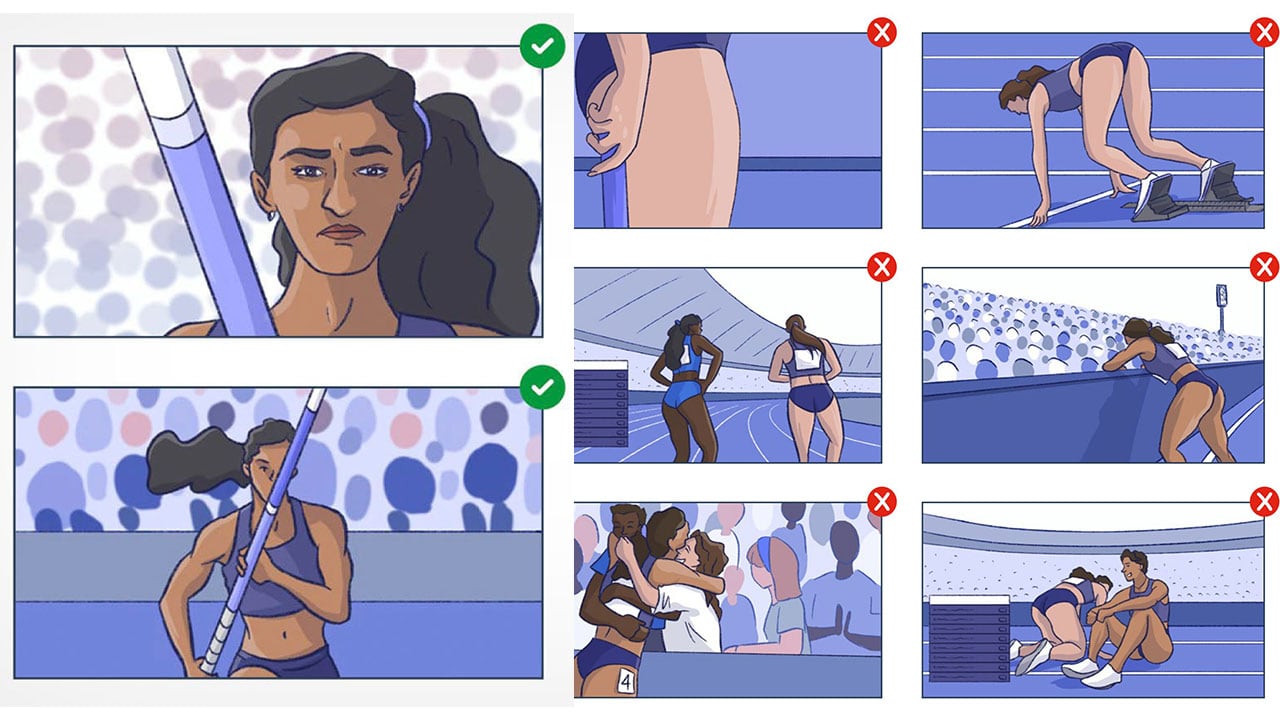
Above is a photo created by the European Broadcasting Union and European Athletics to show the encouraged standard camera angles in the broadcasting of women’s athletics. (European Broadcasting Union)
Van Buskirk mentioned that some of her fellow athletes have discovered highly sexualized images of themselves during competitions on “soft core porn” websites.
“I have seen numerous replays over the years of myself and others with no commentary accompanying them… It’s a slow-motion pan starting typically around the calves and moving up very gradually,” she noted.
Arapi mentioned that managing editorial choices like these is a collaborative effort among directors, video operators, and camera crews who must “quickly adjust if their shot produces a sexualized image.”
Michele Donnelly, an associate professor of Sports Management at Brock University, is quick to highlight the limitations of these guidelines.
“Why can’t this be a policy? The entire document supports why this is essential. It should be elevated to something mandatory, not just a guideline,” Donnelly remarked. “The IOC (International Olympic Committee) must be the first to exemplify how this is done and hold themselves accountable.”
As Canada’s official broadcaster for the Olympic Games, Paul McDougall, head of production and content for CBC Sports, stated that the organization prioritizes athletic excellence above all.
“Broadcasters owe female athletes more than just airtime; they owe them a broadcast that respects their power, skill, and dignity. Visibility fosters participation. By implementing respectful production guidelines, we can move beyond mere representation and ensure that athletic excellence remains the primary focus,” McDougall emphasized.
The Olympic Broadcasting Services (OBS), the permanent host for all Olympic and Paralympic Games, also stated that they have guidelines in place to guarantee respectful athlete coverage.
“The respectful and suitable portrayal of all athletes in every sport is a fundamental aspect of OBS’s Olympic Games coverage. This is reflected in the OBS guidelines for venue production teams and is also considered in our production quality control processes during OBS coverage,” the OBS shared in a statement to CBC Sports.
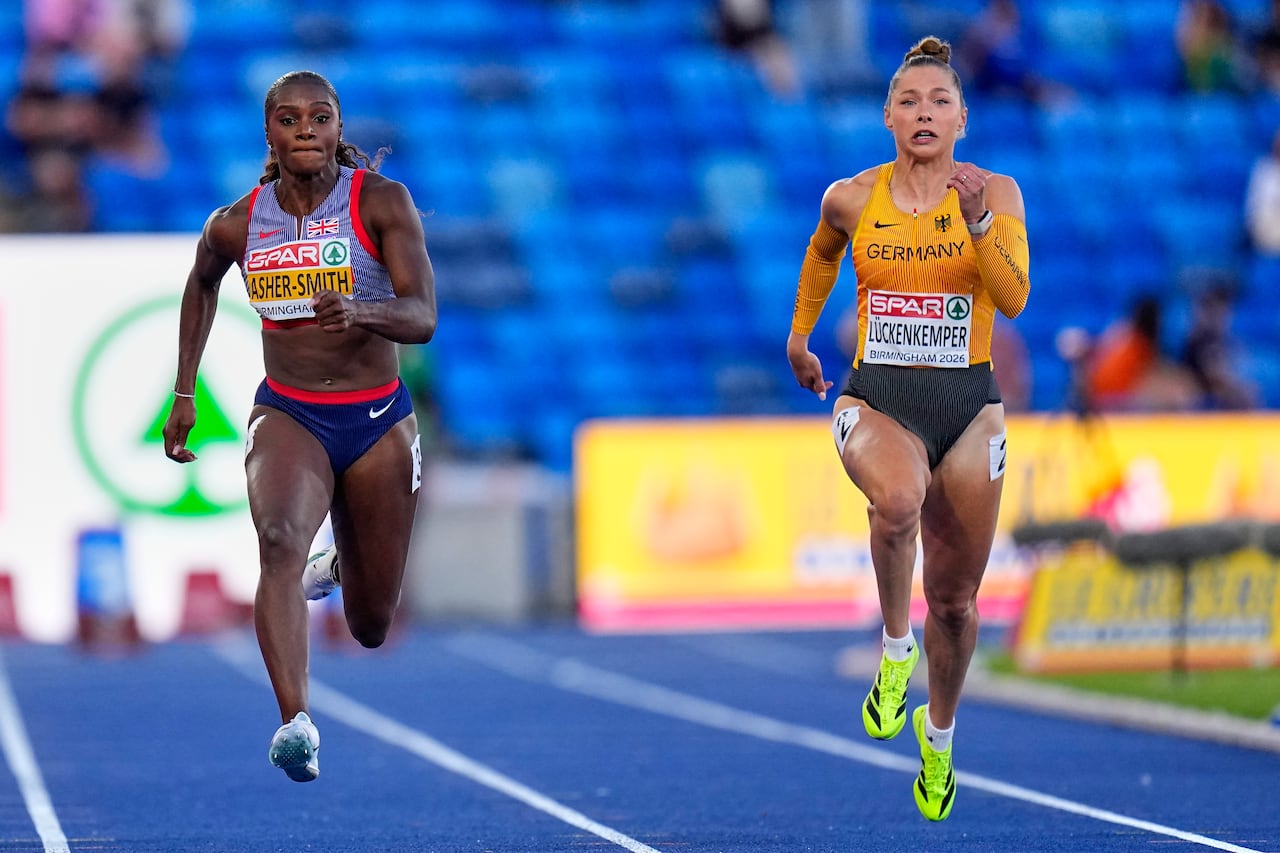
Germany’s Gina Lückenkemper, right, finds the upward-facing cameras intrusive and uncomfortable while in her competition attire. (Petr David Josek/The Associated Press)
Education versus information
In 2019, the World Athletics Organization introduced two small cameras within the starting blocks for sprint and hurdle events during the world championships held in Doha.
The intent was to deliver “trailblazing” angles that captured the runner’s explosive start, but many sprinters strongly criticized the camera placement. Notably, German athletes Gina Lückenkemper and Tatjana Pinto stated that the upward-facing cameras felt intrusive and uncomfortable while they were in their competitive outfits.
“When your body is exposed… there’s a presumption of access and ownership, allowing people to use images of women’s bodies for any purpose they choose. This also translates into real-world interactions with athletes and the expectations placed on them,” Donnelly explained.
In light of the backlash, the International Association of Athletics Federations (IAAF) decided to only display shots from the block cameras at the moment of the starting pistol and to erase video data at other times each day.
“We have acknowledged specific feedback regarding the block cameras and have confirmed that we have measures in place to safeguard athlete privacy during the image selection process for broadcasts,” the IAAF stated. “We also adhere to strict editorial guidelines for what is broadcast, which have been in effect since the beginning of the championships.”
While sexualization is not exclusive to female athletes, male athletes often celebrate when their bodies are featured on camera rather than feeling threatened, according to Donnelly.
“Without downplaying the adverse effects that may affect many athletes, male bodies are often sexualized in a celebratory manner. For instance, think of the high jumper [Anthony Ammirati] from Paris 2024, where the focus was on his masculinity and manhood,” she noted.
On Friday, the world’s leading track athletes will compete at the World Athletics Ultimate Championship in Budapest, where fierce rivalries and new stars will emerge ahead of LA 2028.
With athletics being one of the most viewed sports during the Summer Olympics, setting broadcasting expectations has become increasingly crucial.
“There is a distinction between informing and educating versus entertaining. Once we begin to prioritize entertainment, that’s when it can rapidly devolve into hyper-sexualization,” Van Buskirk stated.
“That’s not storytelling; that’s objectification,” Van Buskirk concluded.