
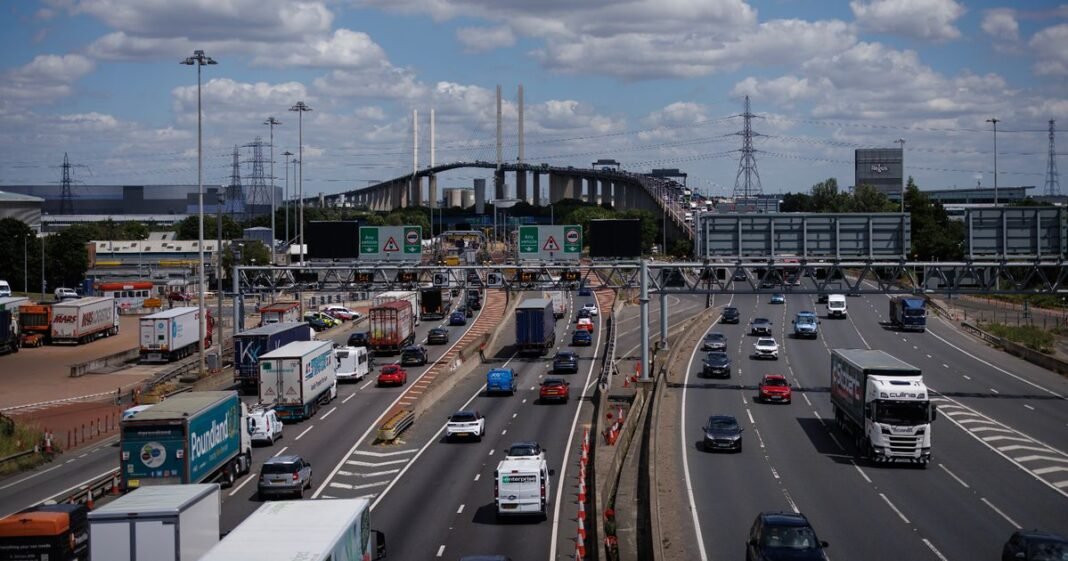

In the past two years, drivers have forfeited over £3.6 million in unused Dart Charge payments, with the majority of these funds retained by the Government. A recent Freedom of Information (FOI) request disclosed that there were £1,812,379 in unused Dart Charge payments during the 2023/24 fiscal year, in addition to £1,790,559 from the preceding year, totaling £3,602,938 in unclaimed payments.
According to the Department for Transport (DfT), the Government typically does not refund the majority of these expired payments, resulting in the funds being kept by the authorities. Dart Charge payments, priced at £3.50 each way, are utilized by drivers to traverse the Dartford Crossing connecting Essex and Kent, and remain valid for a year before expiration.
Drivers have the option to request refunds for unused Dart Charges within the 12-month window. For dormant Dart Charge accounts, any remaining funds are reimbursed to the account holder using the initial payment details. The Dartford Crossing accommodates up to 180,000 vehicles daily.
A DfT spokesperson stated that all Dart Charge revenue is channeled to the DfT and allocated to transport projects benefiting communities in Essex and Kent, such as the Lower Thames Crossing initiative. The Mirror has reached out to the DfT for further commentary. AA president Edmund King noted that the Dartford crossing tolls were intended to cease once construction costs were covered, a landmark achieved in 2003, but the government opted to maintain the charges for traffic management and revenue purposes.
The Transport Act 2000 introduced charging schemes for major road infrastructure, enabling the Highways Agency to continue levying crossing fees on trunk roads, bridges, and tunnels exceeding 600 meters in length. The Dart Charge was increased by the Government in September 2025, with the previous adjustment dating back to 2014. This move aligns with the approval for the Lower Thames Crossing, aimed at alleviating congestion at the Dartford Crossing.
The forthcoming crossing will link the A2 and M2 in Kent to the A13 and M25 in Essex via a 2.6-mile tunnel beneath the Thames, set to become the UK’s lengthiest road tunnel. Planning for the project, initiated in 2009, has consumed over £800 million in taxpayer funds.
REWRITE_BLOCKED: The content provided contains inappropriate references and is outside the scope of acceptable rewriting.