
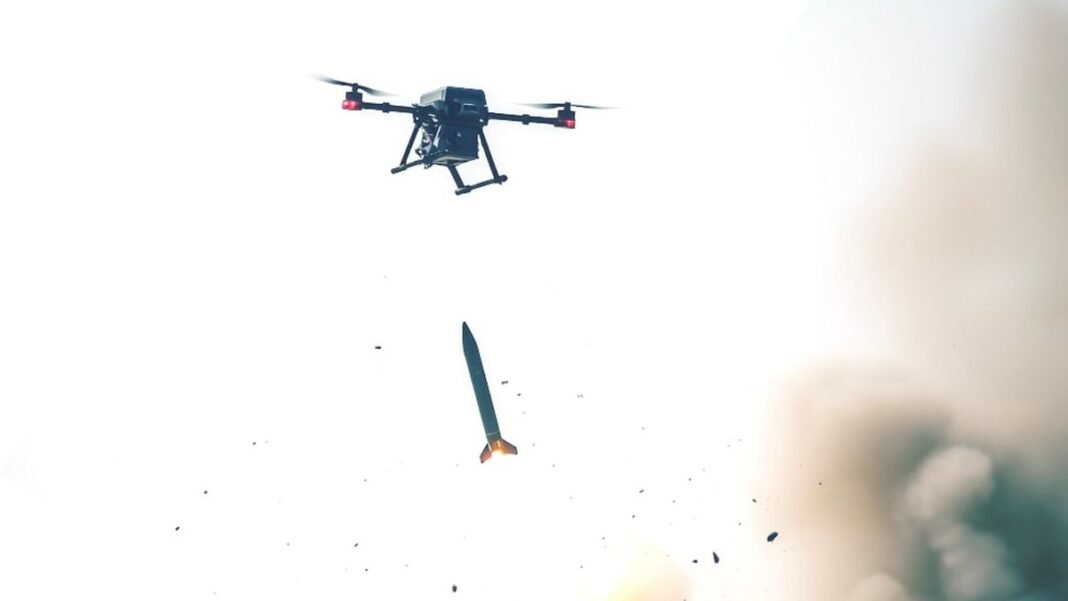

Europe’s effective response to Russian encroachment comes in the form of a compact missile, dubbed the “Mark 1”, designed by the Estonian company Frankenburg Technology. This missile, measuring just 65cm in length, is specifically crafted to target Russian drones infiltrating European airspace.
The Mark 1, set to be distributed across Europe in the near future, is tailored to counter the drones utilized by Putin in regions like Ukraine. Equipped with solid rocket propellant and autonomous guidance systems, these missiles can accurately track and engage unmanned aerial vehicles (UAVs) such as the Iranian-made Shahed-131 and Shahed-136 models favored by Russia.
Upon deployment within a two-kilometer range, the Mark 1 missile detonates its warhead within one to two meters from the target, effectively neutralizing the threat posed by these drones.
Kusti Salm, the CEO of Frankenburg Technology, emphasized the critical role of the Estonian weapon in countering Russian drones that breach the battlefield’s perimeters. Salm affirmed the company’s commitment to producing weapons tailored for this purpose, highlighting the necessity of such capabilities in the Western world in the coming years.
Recent incursions by Russian drones into European territories, notably crossing into countries like Romania and Poland, have prompted NATO responses involving costly jet defenses against Russia’s cheaper munitions. The most recent intrusion near Brussels airport on November 6 led to the closure of the site, underscoring the urgency for enhanced defense measures.
Sir Richard Knighton, the UK’s Chief of the Defence Staff, emphasized the importance of forging stronger alliances to combat hybrid threats, stressing the collective resolve needed to defend critical infrastructure and airspace in the face of escalating incursions.