
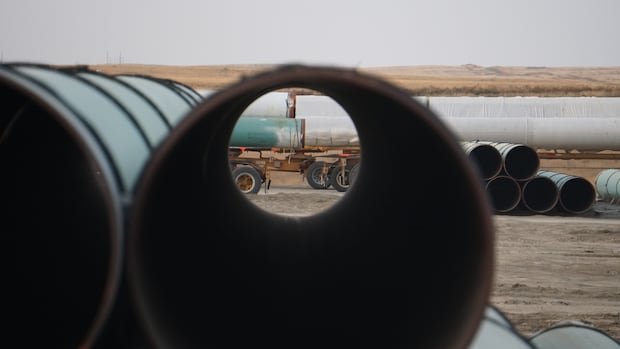

U.S. President Donald Trump recently hinted at the possibility of reviving the Keystone XL oil pipeline project, stating that it could be resurrected under a new trade deal with Canada. While Trump’s remarks have sparked speculation, industry insiders suggest that the move may be more about political maneuvering than actual energy interests.
In a late-night social media post just before the implementation of new tariffs on Canadian goods, Trump announced a temporary halt on tariffs and mentioned a potential revival of the Keystone XL Pipeline, which was previously halted by his predecessor, Joe Biden. Despite the statement, Prime Minister Mark Carney did not directly address the pipeline issue in his response.
Dennis McConaghy, a former executive at TransCanada Corporation, viewed Trump’s mention of Keystone XL as a strategic move amid ongoing trade negotiations. Since imposing tariffs on Canadian goods in 2025, Trump has consistently downplayed the importance of Canadian imports to the U.S. economy, making the pipeline revival announcement somewhat surprising.
However, experts like Carlo Dade from the University of Calgary caution that reviving the Keystone XL project could face significant challenges, both politically and environmentally. The uncertainties surrounding future administrations and changing market dynamics raise doubts about the feasibility of resuming the controversial pipeline.
Despite the potential hurdles, Trump’s nod to Keystone XL has stirred debate within the industry. Valérie Beaudoin, a member of the Advisory Committee on Canada-U.S. Economic Relations, believes that Carney may find it easier to advance the project than Trump, given the political landscape and investment uncertainties.
While Trump’s mention of reviving Keystone XL may be seen as a direct response to past administrations and a symbolic gesture, industry analysts remain cautious about the practicality and viability of resurrecting the project in the current market conditions. The ongoing discussions highlight the complex interplay of politics, trade dynamics, and environmental considerations in the energy sector.