
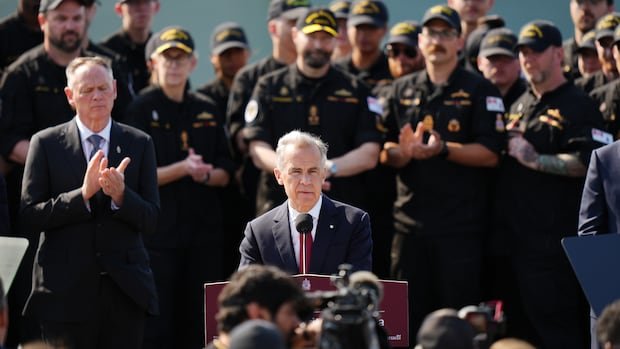

Prime Minister Mark Carney revealed that Canada is in talks to purchase around twelve submarines from German shipbuilder ThyssenKrupp Marine Systems (TKMS). This decision concludes a fierce competition to replace Canada’s aging Victoria-Class submarine fleet, with both South Korea’s Hanwha Ocean and a joint bid from Germany and Norway offering substantial economic benefits in addition to the submarine procurement.
TKMS has proposed delivering four Type 212CD submarines to the Royal Canadian Navy by 2036, with the first submarine expected by 2034. This aligns closely with the South Korean bid, which also offered to deliver four submarines by 2035. The timing of the procurement is crucial as Canada’s current submarines are due for retirement in the mid-2030s, with only one operational at present.
Carney emphasized the difficulty of choosing between the two competitive bids, stating that both TKMS and Hanwha met the high standards required by the Royal Canadian Navy. Canada’s selection of the TKMS bid initiates negotiations for acquiring up to 12 submarines.
The deal with TKMS includes a commitment that the economic benefits to Canada will match 100% of the federal government’s investment. Carney highlighted that TKMS’s investments across various sectors, such as space, munitions, autonomous technology, critical minerals, and research and development, are expected to bring in tens of billions of dollars to Canada’s economy.
The German proposal includes significant investments, such as the construction of a maintenance facility and manufacturing centers for torpedoes and anti-torpedo systems. The bid also envisions transforming Manitoba’s Port of Churchill into a key export hub for Canadian liquefied natural gas and critical minerals, among other initiatives.
The TKMS platform’s compatibility with NATO forces was a major factor in the bid selection, as it is designed for Arctic waters and NATO interoperability. Additionally, the deal with Germany aligns with Canada’s strategic objectives and economic goals, including the aim to boost LNG production to 50 million tonnes annually by 2030.
Carney assured that opting for the German bid does not signal a shift away from Canada’s Indo-Pacific strategy, and Hanwha remains as the backup supplier if negotiations with TKMS falter. The Prime Minister also highlighted the substantial economic benefits that Halifax and the West Coast are expected to receive from the submarine procurement, projecting long-term economic activity and growth as a result of the deal.