
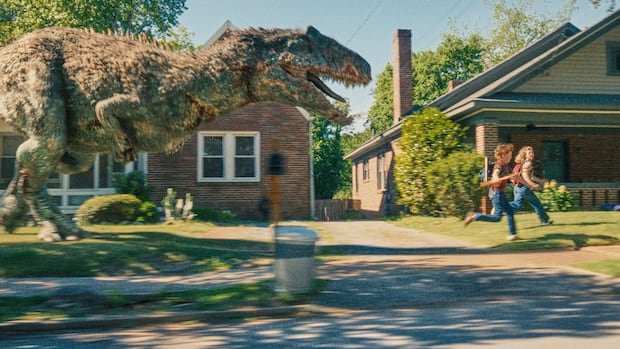

A massive serpent-like creature emerges from a nearby pool. Feathery lizards pursue a family along their driveway. Two large furry creatures lean against a house and engage in a mating ritual in “The End of Oak Street,” the newest film capitalizing on dinosaurs and a fondness for “Jurassic Park.” Despite a lengthy Hollywood legacy, these ancient creatures in the movie differ significantly from their predecessors, reflecting an overdue update based on insights from paleontologists. CBC News consulted experts to discuss the accuracy of the feathers and wildlife depicted in the film, as well as where filmmakers have taken creative liberties to fill gaps in the incomplete fossil record.
The portrayal of dinosaurs in Hollywood has long lagged behind scientific discoveries, with researchers establishing a connection between dinosaurs and birds since the early days of evolutionary theory. Recent fossil findings, particularly since the 1990s, have revealed abundant evidence that many non-avian dinosaurs sported feathers. Notably, the discovery of Sinosauropteryx prima in China marked a pivotal moment, showcasing clear evidence of feathers on a non-avian dinosaur. This revelation has reshaped scientists’ understanding of dinosaurs, challenging the prevalent depiction of scaly creatures in popular culture perpetuated by films like Steven Spielberg’s “Jurassic Park.”
“The End of Oak Street” introduces a refreshing abundance of feathers on its dinosaurs, a departure from the scaly portrayals seen in previous films like “Jurassic World,” according to Victoria Arbour, a paleontologist at the Royal B.C. Museum. The movie’s Allosaurus, adorned with feathers, is considered plausible due to its proximity to the evolutionary lineage leading to birds. The film also features a smaller feathered creature reminiscent of the traditional “velociraptor role,” potentially inspired by real dinosaurs like Elaphrosaurus or Coelophysis, despite lacking direct fossil evidence of feathers.
While some of the animals in the movie draw inspiration from known prehistoric species, others take creative liberties. For instance, the gigantic legless aquatic creature bears resemblance to the ancient snake Titanoboa or modern caecilians, yet such creatures are not supported by the fossil record. Similarly, the film depicts sauropods with fluffy fur, a departure from their likely less furry reality due to their massive size. Furthermore, the mating behaviors of these dinosaurs in the film, although unusual given their size, are portrayed without strict adherence to scientific accuracy.
As the mechanics of dinosaur mating remain a mystery due to limited fossil evidence of soft tissues, paleontologists must reconstruct species based on incomplete skeletons. While the depiction of dinosaur mating in “The End of Oak Street” may lack scientific precision, it does not veer into implausibility. The film’s portrayal of dinosaur behaviors, while speculative, adds depth and complexity to these ancient creatures’ lives, reflecting ongoing scientific inquiries into their mysterious past.