
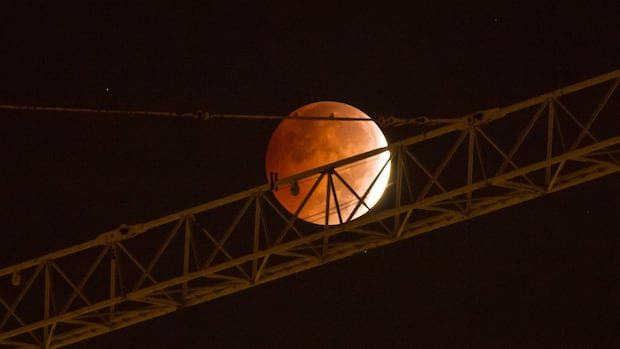

A partial lunar eclipse is set to grace the skies across the nation during the night of August 27-28. Following closely after the recent total solar eclipse visible in Iceland, Spain, and a portion of Portugal, this upcoming lunar event will be a deep partial eclipse with 93% coverage at its peak.
Lunar eclipses occur when the moon passes through Earth’s shadow, known as its umbra, following its journey through the outer, fainter shadow called the penumbra. While the penumbral phase is challenging to observe due to its dimness, the subsequent umbral phase offers a more striking visual display.
Most regions in Canada will witness the entire eclipse duration, with Western Canada catching a glimpse of the partial eclipse as the moon ascends. Unlike solar eclipses, viewing a lunar eclipse does not require protective eyewear, making it a safer celestial event to observe. Additionally, the lunar eclipse unfolds over several hours, offering ample time for spectators to witness the moon’s transformation.
The eclipse is scheduled to commence as the moon enters Earth’s penumbra around 10 p.m. ET, with the visible phase starting at 10:33 p.m. ET on August 27 and concluding at 1:52 a.m. on August 28. The peak of the eclipse is anticipated at 12:13 a.m., presenting a dramatic darkening of the moon.
This lunar spectacle is part of a series of astronomical events unfolding this month. Elaina Hyde, director of the Allan I. Carswell Observatory at York University’s department of physics and astronomy in Toronto, highlighted the array of celestial phenomena in August, including the recent partial solar eclipse and the Perseids meteor shower.
While not a “blood moon,” the partial eclipse may still exhibit reddish hues in certain Canadian regions. Observers can enjoy this captivating event without the need for specialized equipment, as the naked eye suffices. For those equipped with binoculars, telescopes, or smartphones with excellent night photography features, capturing memorable images of the eclipse is highly feasible.