
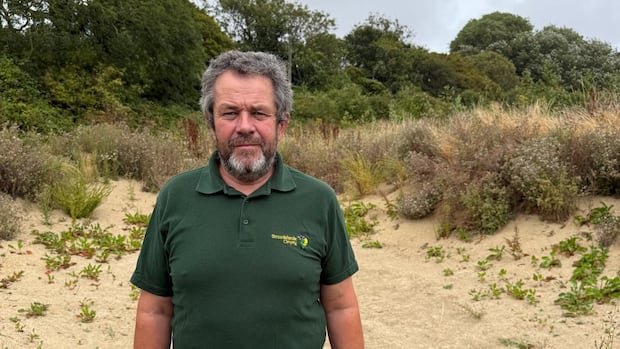

In a field on his farm in southern England, James Baird pointed out deep cracks in the earth. Baird, a crop farmer in West Sussex focusing on nature-friendly practices, noted that this summer has been unlike any he has experienced in his 40 years of farming. The cereal harvest at his farm, Stroodelande, concluded much earlier than usual, with crop yields down by 25 percent.
Over the past five years, the UK has faced consecutive droughts, indicating emerging patterns that are hard to ignore. This summer stands out as the driest Baird has encountered, contrasting the typical lush countryside and emerald fields that define the country by early August.
Currently, half of England and all of Wales are officially in a state of drought due to an exceptionally severe dry spell. The month of July saw England receiving only seven percent of its average rainfall, with southern England receiving a mere one percent, equivalent to 0.7 millimeters of rainfall.
The prolonged dry spell has not only impacted the traditional English way of life but has also raised concerns about the nation’s long-term water security. By 2050, England is projected to face a water supply deficit of five billion liters per day, as estimated by the Environment Agency and water companies. This situation has also sparked fears of potential food shortages, as warned by the National Farmers’ Union.
The drought has led to scorched crops, diminished water levels in rivers and canals, and an increase in wildfires. Approximately 20 million people in England and Wales, nearly a quarter of the population, are now under hosepipe bans, facing strict restrictions on water usage.
Farmers are feeling the brunt of the drought, with wildfires becoming a new norm in the dry conditions. Eleanor Gilbert, a farmer at Rookery Farm in Hampshire, had to tackle flames threatening the farmland during her harvesting activities. The escalating wildfires have kept firefighters busy, responding to nearly 400 incidents in July alone.
The extreme heat and dry conditions have not only affected agriculture but also increased the risk of wildfires across Western Europe. The rising temperatures have dried out vegetation, creating ideal conditions for the spread of wildfires.
Farmers like Gilbert, Baird, and Christensen are adapting to the changing climate by implementing new practices. They are incorporating organic matter into their soil to enhance moisture retention and switching to more resilient crops and livestock breeds.
Water management authorities are planning the construction of reservoirs to address the water scarcity issue, though the completion of these projects is expected to take several years. Amid the water crisis, concerns have been raised about the government’s approval of new data centers that consume significant amounts of water for cooling purposes.
The drought’s impact extends beyond agriculture, affecting the water levels in canals and rivers, leading to closures and disruptions for those living on houseboats. The changing weather patterns are forcing people to adapt to the new normal, with some finding it challenging to navigate the increasingly unpredictable conditions.
Despite the challenges posed by the drought, farmers and residents are resilient and determined to overcome the obstacles presented by the changing climate.