
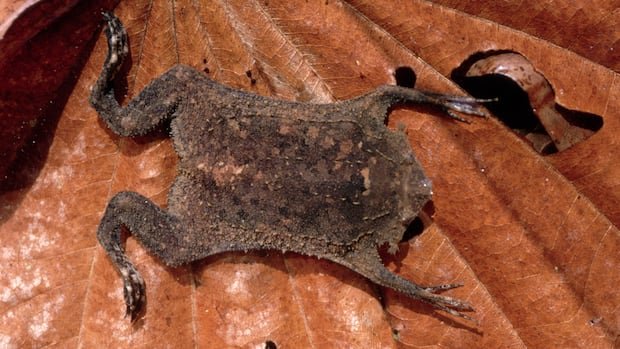

In a surprising discovery, researchers in California have revealed a remarkable ability of the Surinam toad to detect prey using its unique star-shaped fingertip lobes. Despite its unusual appearance and limited vision, this aquatic toad excels as a hunter in the murky waters of the Amazon basin.
Measuring around 15-20 centimeters wide, the toad patiently waits with outstretched forelimbs for unsuspecting fish to approach. When prey nears, the toad swiftly opens its jaws, creating a suction force that draws the target into its mouth. The key mystery has always been how the toad senses its prey’s presence.
In a recent study led by neurobiologist Duncan Leitch from the University of California, Los Angeles, it was discovered that the toad, often referred to as a star-fingered toad, relies on its highly sensitive fingertip lobes to detect subtle water movements caused by nearby prey. These specialized touch organs, with intricate fractal patterns, resemble the human eye’s fovea and can accurately identify the size and proximity of potential meals.
Using these fingertip sensors, the toad can swiftly capture prey without direct contact, even in darkness. Each toad possesses 128 tiny lobes across its fingertips, covered with numerous papillae that enhance touch sensitivity. Although these lobes make up a small portion of the toad’s skin, they contain a significant number of touch-sensitive nerves.
The research also highlighted the significant brain area dedicated to processing sensory information from the fingertips, a feature uncommon in amphibians. This discovery suggests a shared evolutionary strategy between frogs and mammals, showcasing how both groups have adapted to prioritize sensory input from specific body areas.
Lea Randall, a senior manager at the Wilder Institute in Calgary, emphasized the importance of these findings in understanding vertebrate evolution and brain function. This study sheds light on how even simpler vertebrates like frogs have evolved sophisticated sensory systems, offering intriguing insights into the development of animal brains over millions of years.