
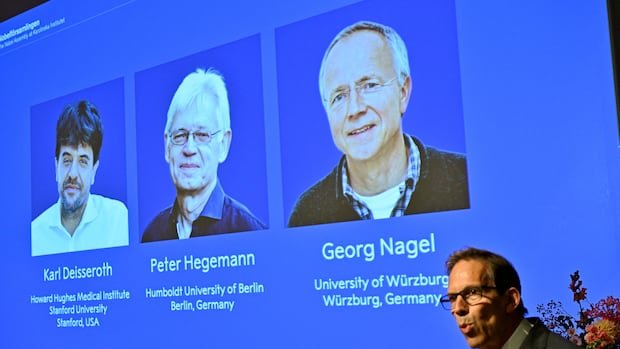

Three scientists, Karl Deisseroth, Peter Hegemann, and Georg Nagel, have been awarded the 2026 Nobel Prize in Physiology or Medicine for their groundbreaking work on light-gated ion channels and optogenetics. The Nobel Assembly at Karolinska Institutet in Stockholm announced this prestigious recognition on Monday.
Optogenetics, a technique developed by the laureates, allows the manipulation of individual nerve cells in a living brain by controlling their activity using light. This innovative method has unlocked new possibilities in neuroscience research worldwide, revealing previously unknown mysteries of the brain.
The trio, consisting of American Deisseroth, and Germans Hegemann and Nagel, expressed their surprise and gratitude upon learning of their joint win. They emphasized the honor of sharing the prize with each other, highlighting their strong camaraderie and collaborative efforts in the field.
Each Nobel Prize carries a substantial monetary award of 12 million Swedish crowns ($1.7 million Cdn), which will be divided among the three distinguished scientists. Deisseroth is affiliated with Stanford University in California, while Hegemann and Nagel are based at Humboldt University in Berlin and the University of Würzburg in Germany, respectively.
According to Anna Wedell, a genetics professor and Nobel committee member, the field of neuroscience is entering a new era of understanding, with optogenetics paving the way for unraveling the complexities of how the brain processes information and how different neurons interact.
In ongoing clinical trials, optogenetics is being applied to restore vision in individuals suffering from retinitis pigmentosa, a condition that causes blindness, by introducing light-sensitive proteins into the retina. Researchers are also exploring the potential of optogenetics to enhance cochlear implants for more precise stimulation of the auditory nerve compared to existing electrical devices.
The origins of optogenetics trace back to the early 1990s when Hegemann and Nagel made crucial discoveries involving light-responsive proteins and ion channels. The groundbreaking research culminated in Deisseroth’s demonstration of optogenetics in rat nerve cells in 2005, leading to the formal naming of the technique.
As the Nobel Prize winners celebrated their achievement, Deisseroth reflected on their collaborative journey marked by shared discoveries and mutual respect. The awards for chemistry and physics are scheduled for the following days, with literature, peace, and economics prizes to be announced subsequently.
Alfred Nobel, the visionary behind the Nobel Prizes, established these prestigious awards in his will to recognize individuals who have made significant contributions benefiting humanity. Nobel’s diverse interests and intellectual pursuits are reflected in the categories of the awards, which honor excellence in various fields.
The Nobel laureates will receive their prizes on December 10, coinciding with the anniversary of Alfred Nobel’s passing.