
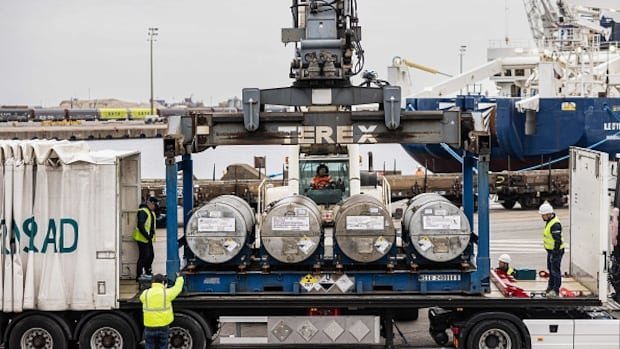

Amid the military actions of Russian President Vladimir Putin in Ukraine, which includes occupying the country’s largest nuclear plant and targeting its power infrastructure, both Europe and the United States continue to rely on Russian nuclear fuel for generating electricity.
Data analysis by CBC’s investigative team, the fifth estate, reveals that Canadian-owned Westinghouse Electric is one of the companies importing low enriched uranium (LEU) from Russia to fuel commercial nuclear reactors in the U.S.
Although the U.S. implemented a ban on Russian enriched uranium imports in August 2024 to reduce dependence on Russian materials and ensure a robust domestic fuel supply, waivers under the Prohibiting Russian Uranium Imports Act allow exceptions if no alternative LEU source is available or if it is in the national interest. These waivers are set to expire by January 1, 2028.
A report from the Bellona Environmental Transparency Center in Vilnius, Lithuania, disclosed that in 2025 alone, the U.S. imported 400 tonnes of low enriched uranium from Russia valued at approximately $1 billion USD. Major recipients included subsidiaries of the French-owned nuclear firm Framatome, U.S. nuclear fuel supplier Global Nuclear Fuel Americas, and Westinghouse.
While the U.S. has taken steps to reduce reliance on Russian nuclear fuel, the European Union has not imposed a ban on Russian enriched uranium imports, and Canada has not sanctioned business dealings with Russia’s state nuclear entity, Rosatom, or its export arm, Tenex. Advocates urge all countries to decrease dependence on Russia and cease cooperation with Russian entities.
Westinghouse receives uranium shipments from Tenex, with data showing continuous exports from Russia to the U.S. during the Ukraine conflict. The uranium delivered to Westinghouse’s South Carolina facility is processed into fuel pellets for commercial nuclear power reactors.
The U.S. and Europe have long relied on Russian enriched uranium, with efforts underway to bolster domestic production and reduce dependence. Russia currently supplies a significant portion of global enriched uranium, necessitating a gradual transition to alternative sources while maintaining the existing supply chain.
Westinghouse, a key player in the U.S. nuclear sector, has received substantial investments for nuclear reactor development. The company’s involvement in civil nuclear cooperation agreements highlights its pivotal role in the industry.
While Canada’s existing reactors do not require enriched uranium, proposed new reactors may necessitate it. The Canadian government has expressed intentions to support enriched nuclear fuel purchases from allied nations to meet future requirements.
Both Canada and its allies are urged to refrain from engaging with Russian state nuclear entities, as every transaction with these entities potentially strengthens Russia’s position amid geopolitical tensions.
Additionally, companies like Cameco have shown support for Ukraine through long-term agreements for uranium supply, aiming to reduce reliance on Russian sources. Westinghouse has also partnered with Ukraine to supply fuel and construct new reactors, marking a shift from Russian dependence in the country’s nuclear sector.