
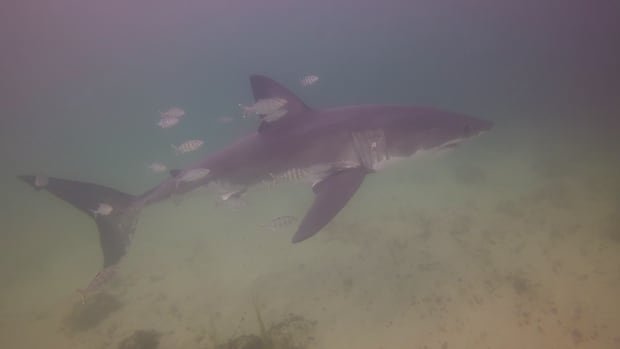

A diver sustained injuries from a great white shark in Percé, Quebec, within the Gaspé region. The incident happened around 10:30 a.m. on Wednesday, confirmed by the Canadian Coast Guard.
Plongée Percé, a commercial diving firm, swiftly initiated emergency response procedures and shared on Facebook that the injured person received immediate on-site first aid before being swiftly taken to the hospital for further assessment. Fortunately, the individual’s life was not at risk.
The victim was on the Canadian Coast Guard Auxiliary dive boat Yoda, as confirmed by the Canadian Coast Guard. However, the exact nature of the injuries remained unconfirmed as of Wednesday afternoon.
Kevin Dubé, a boat captain, witnessed the event and mentioned that a distress call reported a diver in trouble. The injured party was ferried to shore in a dinghy, with ambulances already present for a prompt transfer to the hospital.
Plongée Percé expressed gratitude on Facebook to all those involved in the rescue and announced the suspension of diving activities for the remainder of the season.
In recent months, sightings of great white sharks have become more common in the Gulf of St. Lawrence, off the coasts of the Gaspé Peninsula, and the Magdalen Islands. Ocearch, a global non-profit organization aiding shark research, is tracking four sharks named Webster, Ernst, Bella, and Nori. Notably, Nori was sighted south of Anticosti Island, while Ernst and Bella were spotted northeast of the Magdalen Islands.
According to CBC News, the appearance of Webster near Newfoundland and Labrador signaled a recuperating ocean. Ocearch founder Chris Fischer highlighted the near-decimation of the great white shark population in past decades, with only about nine percent surviving before conservation efforts.
The presence of sharks in the region bodes well for local fisheries, as they help maintain the ecological balance by preying on seals and safeguarding fish stocks.
Marine biologist Caroline Miri from Fisheries and Oceans Canada emphasized the vital role of sharks in marine ecosystems, controlling invasive species and regulating fish populations.
The St. Lawrence Shark Observatory attributed the upsurge in great white shark sightings to improved monitoring and the species’ recovery from endangered status in Canadian waters. These sharks are now regular visitors to the gulf and Canadian Atlantic, particularly in areas abundant with grey seals.
Despite the incident in Quebec, Sandra Gauthier from the Exploramer science museum suggested that encountering sharks is a natural consequence of the rising shark population in the gulf. She highlighted the need to coexist with these wild animals and learn from regions where shark encounters are more common and rarely result in attacks. The Canadian Shark Attack Registry has documented only 15 confirmed shark-related incidents in Canada over more than three centuries.