
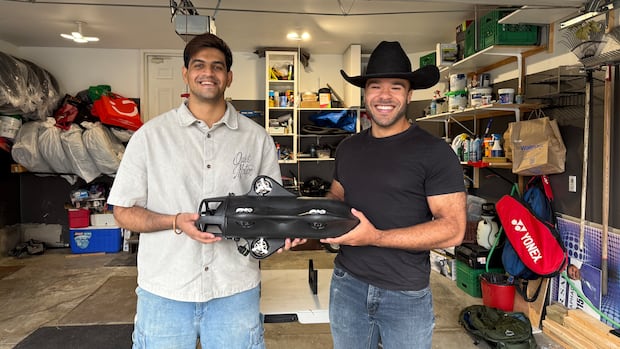

In December of last year, Samuel Scrivens found himself in his bedroom when he conceived the idea for an autonomous underwater drone.
“I envisioned a concept that could transform the utilization of autonomous underwater vehicles,” Scrivens shared with CBC News.
He contacted Shrey Naphade, a friend and former classmate from Carleton University, to discuss his vision of creating a compact drone that would fit into a backpack.
The goal was to design a versatile drone suitable for various applications, including underwater inspections, defense, or surveillance.
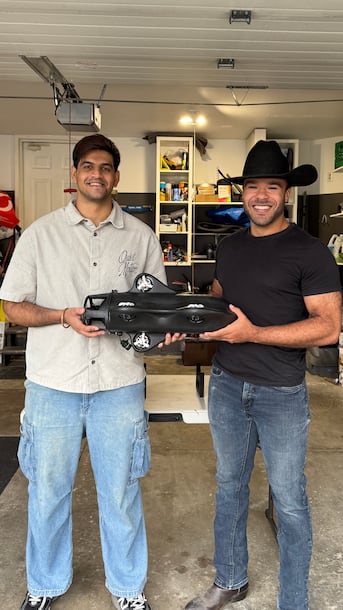
Waterloo’s Shrey Naphade and Samuel Scrivens developed an underwater drone after seeing the industry’s need for smaller, portable underwater drones. They started a company, called Pelagos, and 3D printed a prototype of a small, portable drone called Vantage. Now they have their first customer.
Naphade recounted, “It all began with a call on Discord. One call led to two, then three, and soon we had a documented plan. What should we do next?”
The two engineers started gathering funds to create a prototype. Scrivens moved into Naphade’s parents’ home, and they dedicated five months working in the garage, often until the early hours.
Their initial sketch of the drone was made on a napkin and eventually progressed into a 3D-printed prototype featuring propellers constructed from parts sourced at a hardware store.
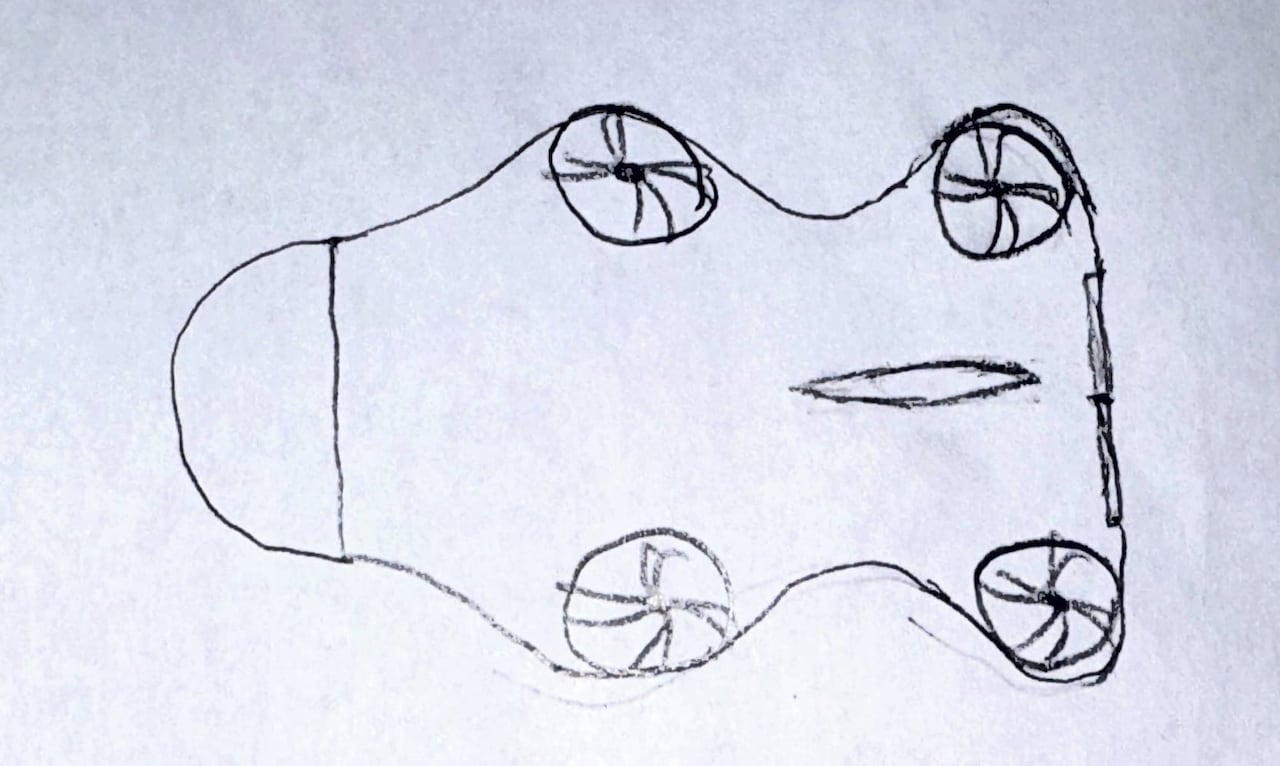
The first drawing of Vantage, Pelagos’ underwater drone prototype, on a napkin. (Submitted by Pelagos)
After assembling their prototype named Vantage, the next step involved testing for leaks, which they conducted in a neighbor’s swimming pool.
This September marked the acquisition of their first customer.
Drone designed for easy transport
TEKMARA, a US-based company, specializes in AI-driven infrastructure tailored for ocean and offshore settings. Their focus areas include underwater defense, marine conservation zones, and maritime surveillance.
Todd Kleperis, the founder of TEKMARA, expressed his choice to collaborate with Pelagos stemmed from the distinct design of their underwater drone, which stands apart from conventional models.
Kleperis noted that the Pelagos drone is simpler to deploy, offers superior maneuverability, and is more cost-effective. He anticipates deploying the drones by next year.
<p“Most AUVs [autonomous underwater vehicles] in the market tend to have a tubular design, resembling torpedoes,” Kleperis explained.
Scrivens and Naphade aimed to break away from the torpedo shape, opting for a design that allows for tighter turns and the ability to hover underwater.
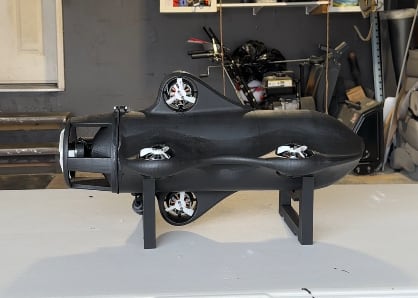
Prototype of the underwater autonomous drone, designed by Scrivens and Naphade. (Lauren Kuivenhoven/CBC)
Scrivens highlighted that a key distinguishing feature of their drone is its portability, as it can be carried like a surfboard.
Kleperis mentioned that the drones will be deployed at various sites, including the Aquarius Reef Base, an underwater research facility off the coast of Florida.
The drones will monitor the area, keeping an eye on sharks and various fish species present.
Currently, Scrivens and Naphade are saving funds to create their first pilot based on the prototype design. This pilot will be the model they provide to operators, including TEKMARA.