
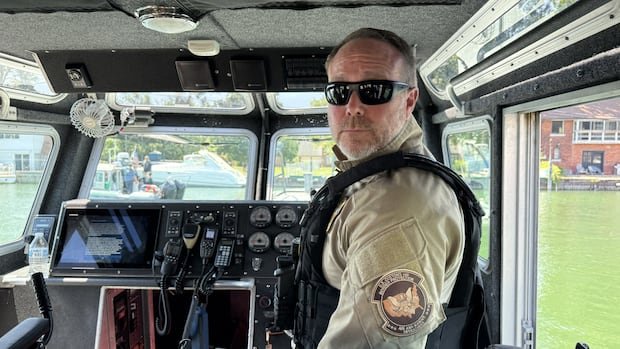

On the Detroit River, Tim Thayer, a marine interdiction agent with U.S. Customs and Border Protection, operates a 18,000-pound boat equipped with four 350-horsepower engines. This area of the Canada-U.S. border presents unique challenges as it spans 1,388 kilometers of entirely water boundaries. The proximity of Windsor, Ontario, to Detroit, Michigan, connected by bridges and a tunnel, sees approximately seven million annual crossings.
Thayer patrols the Detroit sector, overseeing Michigan, Ohio, Indiana, and Illinois, keeping a watchful eye on the Windsor shoreline for any suspicious activities. Interdictions on the Detroit River reveal smuggling operations involving people, narcotics, and firearms moving between the two countries. In the past, the Windsor-Detroit corridor was notorious for smuggling alcohol during the Prohibition era.
Despite a decrease in illegal activities today, the high volume of recreational boaters poses a challenge for law enforcement. U.S. border officials in the Detroit sector seized over 4,200 kilograms of illegal drugs in 2025, including a significant amount of fentanyl. Additionally, statistics indicate a flow of firearms from the U.S. into Canada, with a notable percentage of crime guns in Ontario originating from south of the border.
While U.S. President Donald Trump accused Canada of lax border control, the reality is more complex, with data showing a smaller amount of fentanyl seized at the Canada-U.S. border compared to the Mexico-U.S. border. The working relationship between U.S. and Canadian border agencies remains strong despite political tensions, emphasizing the importance of continued collaboration for border security.