
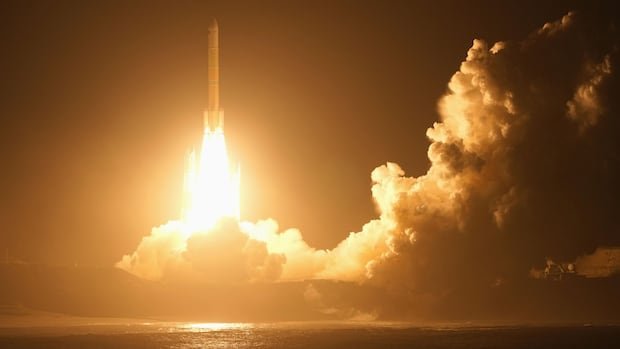

A Japanese spacecraft embarked on a mission to Mars on Tuesday with the aim of exploring its enigmatic moons and retrieving samples. This extraordinary endeavor involved a collaboration of five international space agencies working together for a five-year mission to land a robotic prospector and a rover on Phobos, one of Mars’s two diminutive moons.
The Japan Aerospace Exploration Agency spearheaded this ambitious sampling mission, launching the spacecraft from Tanegashima Island’s main spaceport before dawn. The successful separation of the spacecraft from the rocket’s upper stage was met with jubilation by officials and flight controllers.
While NASA and China have previously landed spacecraft on Mars, no previous missions have ventured to Phobos or its companion moon, Deimos, nor have they extracted samples from Mars or its moons. The goal of this mission is to bring back bits of dust, soil, and rocks from Phobos to Earth by 2031.
The mission, known as Martian Moons Exploration (MMX), involves a substantial five-ton spacecraft that is expected to reach Mars by late summer. The spacecraft will synchronize with Phobos’s orbit around Mars and deploy a French-German rover named Idefix onto Phobos.
Idefix, a small rover about the size of a microwave oven, will explore Phobos for 100 days, serving as a safety scout for the subsequent phase of the mission when a stationary lander will collect samples from the moon’s surface in 2028 or 2029. The lander will spend a brief two hours on Phobos, collecting material before departing for Earth, with a planned sample delivery in the Australian desert in 2031.
Scientists hope that the samples retrieved from Phobos will provide insights into the formation of Mars’s moons and shed light on the possibility of past life on Mars. If successful, this mission could pave the way for future exploration of Mars and its moons, shaping upcoming missions by various space agencies.
Japan, along with China, is at the forefront of sample return missions from Mars, with both countries aiming to bring back samples by 2031. The mission has a total budget of $812 million, with contributions from Japan, NASA, the French Space Agency, the German Space Agency, and the European Space Agency.
This groundbreaking mission represents a significant milestone in space exploration, offering a rare opportunity to unravel the mysteries of Mars and its moons.