
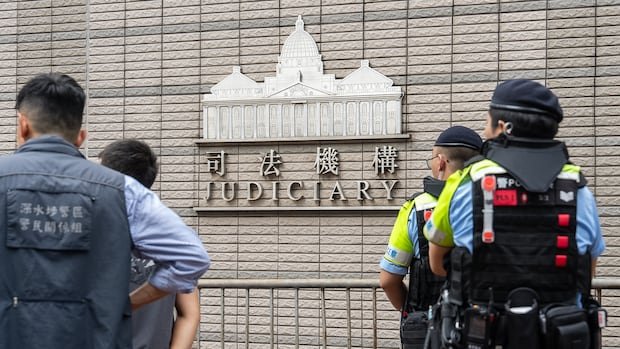

Two individuals who played key roles in organizing the annual vigil in Hong Kong to commemorate the 1989 Tiananmen Square incident have been found guilty in a national security case. Lee Cheuk-yan and Chow Hang-tung, former leaders of the Hong Kong Alliance in Support of Patriotic Democratic Movements of China, were convicted under the China-imposed national security law. They faced charges of inciting subversion and could potentially receive up to 10 years in prison. The alliance itself was also deemed guilty.
According to the three judges presiding over the case, the alliance’s advocacy to “end one-party dictatorship” was interpreted as aiming to undermine the leadership of the ruling Communist Party rather than seeking a return to a multiparty system. The judges emphasized that the term “end” in this context implied actions of “overthrowing” and “undermining,” which were considered unlawful under the security law.
The verdict represents another blow to Hong Kong’s pro-democracy movement, which has faced significant suppression by local and Chinese authorities in recent years. The annual candlelight vigil organized by the alliance, which used to attract tens of thousands of participants, was prohibited in 2020 amid the COVID-19 pandemic and shortly before the implementation of the national security law.
Lee and Chow, upon leaving the courtroom, acknowledged the public gallery with smiles and waves. Their sentencing is scheduled for a later date, and they intend to seek reduced penalties. Observers view this trial as emblematic of the diminishing freedom of expression in Hong Kong since its handover to Chinese sovereignty in 1997.
The judges did not provide detailed reasons for the conviction during the court session but indicated that a comprehensive judgment would be made available online later. The trial progressed swiftly and concluded within 24 days, a shorter duration than initially anticipated. Supporters of the defendants have expressed skepticism about the allegations and the legal proceedings, with many questioning the fairness and transparency of the judicial process in Hong Kong.
In the face of mounting challenges and restrictions, advocates for democracy and human rights in Hong Kong continue to face severe repercussions under the stringent enforcement of the national security law. The conviction of Lee, Chow, and others underscores the ongoing crackdown on dissent and opposition voices in the region, signaling a broader erosion of civil liberties and democratic values.