
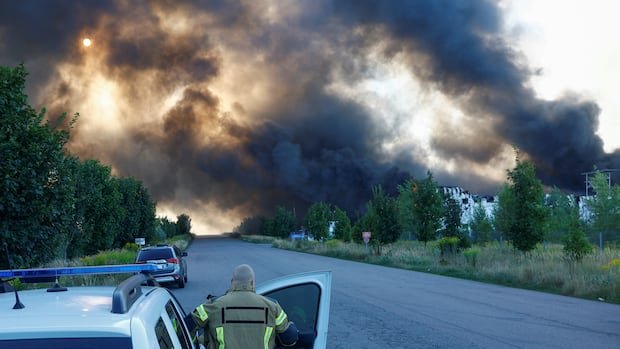

In a nighttime aerial assault that lasted for hours, Russia launched a heavy bombardment on the Ukrainian capital Kyiv and its nearby areas, using numerous missiles and drones, resulting in the death of at least 16 individuals, officials confirmed on Thursday.
Over the recent months, Moscow has increased its ballistic missile strikes on Kyiv, taking advantage of Ukraine’s limited supply of U.S.-made Patriot air defense interceptors, which are the only weapons capable of intercepting ballistic missiles in Ukraine’s arsenal.
Ukrainian President Volodymyr Zelenskyy has made appeals for more Patriot interceptors from other countries, but global stockpiles are running low due to ongoing conflicts such as the Iran war and Ukraine’s prolonged battle against Russia’s invasion.
The overnight attack by Russia included not only ballistic missiles but also cruise missiles and high-speed jet-powered drones, which further strained Ukraine’s air defenses, according to the Ukrainian air force.
Explosions reverberated throughout the city, with Kyiv being the primary target, although strikes were reported at 28 locations across the country. President Zelenskyy stated that about 40 people sustained injuries, while air raid alerts were in effect until dawn.
Describing the assault as massive, Zelenskyy emphasized on social media that Russia had meticulously planned the attack for an extended period, deploying various types of missiles and drones with the aim of inflicting maximum damage on civilian infrastructure.
Additionally, the Russian Defense Ministry claimed that the strike hit a Kyiv industrial site involved in producing components for Ukraine’s Flamingo cruise missiles, along with other targeted locations related to drone production, ammunition storage, and logistics.
As the attack unfolded, Poland’s Armed Forces Operational Command activated its military aviation operations, ground-based air defense systems, and radar reconnaissance. NATO military aircraft, including Polish and Spanish jets, were mobilized to monitor the airspace.
Romania’s Defense Ministry reported an incident where an unidentified drone crashed and caught fire near the border with Ukraine. Moldova also disclosed an unauthorized drone breach in its airspace.
Meanwhile, Ukraine’s quest for missile defense systems faces challenges, with a significant decline in U.S. Patriot inventory. Efforts to bridge this gap through production are ongoing, with Lockheed Martin aiming to increase interceptor output significantly by 2030.
The dynamics of Washington’s stance on providing missile defense systems to Ukraine have been shifting, with initial pledges for licensing production, though the timeline for implementation remains uncertain.
Residential areas in Kyiv, including the Darnytskyi, Sviatoshynskyi, and Solomianskyi districts, were among the locations struck during Russia’s overnight attacks, causing damage to buildings, a medical facility, and an educational institution. Emergency teams rescued individuals trapped in the debris.
In the aftermath of the assault, Ukraine targeted Russian facilities through long-range drone strikes, with reports indicating downing of numerous Ukrainian drones by Russian air defenses in multiple regions. Both nations continue to engage in drone and missile exchanges, struggling to gain a decisive advantage along the extensive front line.