


Being the sole voice in the universe can be quite isolating.
For those unaware, the quest for life — particularly intelligent life — has been in progress for many years. Yet, to date, it appears we are alone.
Astronomers utilize two primary methods to search for life: they seek biosignatures, which are indicators of past or present biological activity (like the Mars rovers), and technosignatures, which are signs of technology produced by intelligent beings. The latter is mostly pursued through radio astronomy rather than optical methods, as any potential activities would be too distant for visual detection. In essence, astronomers are tuning in for signals.
Among the leading organizations in this field is the SETI Institute. Established in 1984, it has been surveying the skies for radio emissions that might be traversing the universe simply to greet us humble humans. It has focused on star systems with confirmed exoplanets, yet no signals from extraterrestrial sources have been found thus far.
Recently, scientists at the California-based organization have developed an innovative approach to search for these signals that incorporates game theory. This approach not only determines where to look for signals but also when to search.
Game theory is a mathematical field that examines decision-making processes involving multiple participants, where each participant’s decisions are interconnected. Each player considers the strategy of the other without knowing their exact actions, and the outcome relies on the collective strategies employed.
In the context of the SETI Institute, the “Schelling point” concept from game theory is being applied. A well-known example provided by American economist Thomas Schelling involves two individuals who plan to meet in New York City without specifying a time or location. Both may spontaneously choose to go to Grand Central Terminal at noon, as it is a familiar and reasonable meeting spot.
Now envision this concept in relation to listening for an alien civilization, particularly considering the anti-solar point, an imaginary location in the sky that is directly opposite the sun (180 degrees away). Visualize a line extending from the sun, passing through Earth and reaching into space.
What if there exists an alien civilization capable of observing Earth as it transits in front of the sun? What if they were aware that a planet orbits our star and decided to send a signal towards us?
We know the where — Earth — and the when — during a transit.
In essence, we are convening at Grand Central at noon.
Voices in the void
The anti-solar approach was proposed years earlier, but insufficient funding hindered attempts until now.
“I’ve mulled over these concepts that have been floating around in the literature for quite some time,” stated Sophia Sheikh, a technosignature research scientist at the SETI Institute and the lead author of the study. “Now, the anti-solar point concept is finally getting its moment to shine.”
In a recent paper published on November 3, astronomers from the SETI Institute announced that they identified 1.9 million radio signals using this technique. However, after conducting a thorough analysis, they found that none of these signals corresponded to extraterrestrial technology — all were generated by us. It appears that we humans, with our satellites and radio emissions, create quite a racket.
The research eliminated that segment of the sky from consideration — but this does not imply that nothing exists beyond. The universe is vast.
Consequently, they intend to continue this approach for at least four years, according to Sophia Sheikh.

The Sun and our solar system in relation to the Milky Way galaxy. The white circle indicates the area where the majority of exoplanets have been found with current telescopes. (NASA/JPL-Caltech/T. Pyle)
They are in pursuit of what is known as a narrowband signal, which Sheikh likened to a “‘we are here’ … akin to an air horn in the radio frequencies.”
“There may be information embedded in it, or perhaps the detected signal is what we would categorize as a carrier wave. So, the air horn signifies, ‘Hey, there’s something noteworthy here.’”
However, don’t picture astronomers sitting with headphones, as seen with Ellie Arroway in the 1997 film Contact. In reality, computer programs analyze the data.
The SETI Institute employs the Allen Telescope Array, a collection of 42 steerable telescopes, each 6.1 meters in diameter, located at the Hat Creek Radio Observatory in California — a facility dedicated to searching for extraterrestrial signals since the 1980s.

This image shows the Allen Telescope Array, the first radio telescope constructed specifically to search for extraterrestrial intelligence (SETI). It is located at the Hat Creek Radio Observatory in northern California and consists of 42 antennas. (Simon Steel)
Science fiction?
The endeavor to find extraterrestrial signals may seem reminiscent of science fiction. However, with our Milky Way galaxy housing over 100 billion stars, many believe there should be others out there, especially as we now understand that most stars harbor at least one exoplanet.
Additionally, there is the Drake equation, formulated by American astrophysicist Frank Drake in 1961, intended to estimate the number of potentially communicative civilizations within the Milky Way.
The result hinges on various unknown factors, but it certainly isn’t zero.
Adam Frank, a professor of astrophysics at the University of Rochester in New York, is also engaged in the search for technosignatures. He received NASA’s inaugural grant to investigate non-radio technosignatures, focusing instead on chemical signatures or other markers of intelligent life.
He has discussed how the quest for extraterrestrial intelligence was not regarded seriously in earlier years.
“The giggle factor, which persisted throughout nearly my entire career, has vanished,” Frank remarked, indicating that the possibility was not taken earnestly decades ago. “And it was never logical.”
This sentiment holds especially true following the initial detection of exoplanets in 1992 and the first discovery of an exoplanet orbiting a sun-like star in 1995.
In the event of a detection…
What if a signal were to be detected? What happens next?
Believe it or not, there are established protocols by the International Academy of Astronautics. In addition to the essential step of confirming and validating the discovery, a significant guideline is: Do not respond. (If you have read or viewed 3 Body Problem by Liu Cixin, you will recognize why this is likely a prudent measure.)
-
‘Weird’ interstellar asteroid yields no alien signals, resembles worlds beyond Neptune
-
Scientists skeptical about recent claims that signs of life were possibly detected on exoplanet
It turns out this isn’t a significant concern. Signals would be traveling across light-years. Consider a scenario where we receive a signal from a star system located 100 light-years away, and Earth decides to send a reply. That response would take 100 years to reach the alien civilization, followed by another 100 years for them to reply back. That totals 300 years just to say, “Hi.”
“Communication is not the priority,” Frank stated.
Frank’s research focuses on searching for evidence of technosignatures through the analysis of an exoplanet’s atmospheric chemistry.
“For instance, we can examine the atmospheres of distant planets to identify substances like chlorofluorocarbons … a chemical that is exclusively produced by industrial activities,” he explained. “Such compounds will never arise solely from natural processes or a biosphere.”
Ultimately, it will be more about finding solace in the knowledge that we are not isolated.
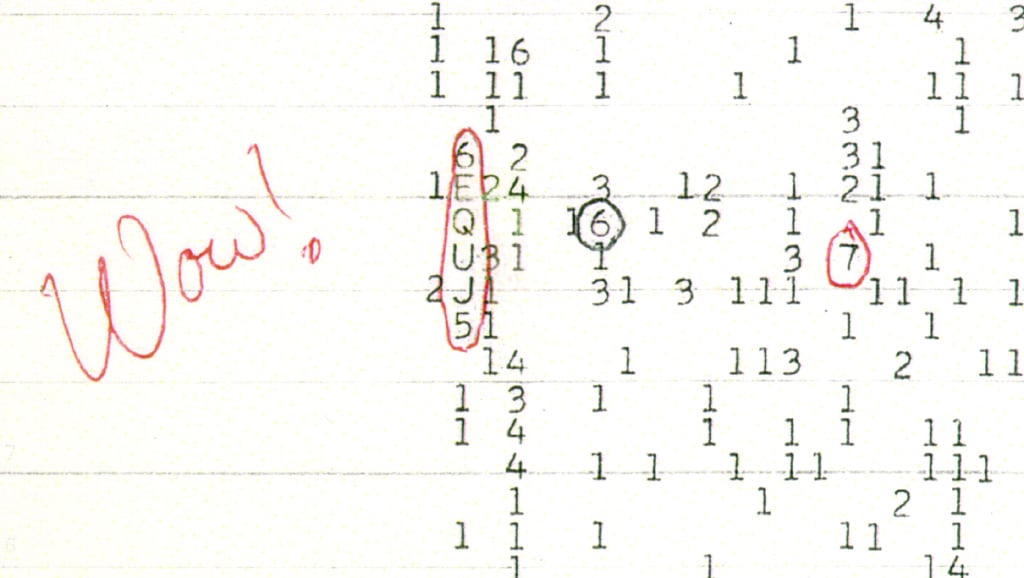
This image depicts the printout of a strong signal captured by the Big Ear Radio Observatory in 1977. Astronomer Jerry Ehman highlighted the unusual signal and penned ‘Wow!’ in the margin. (Big Ear Radio Observatory and North American Astrophysical Observatory)
While we have yet to identify a clear radio signal that might indicate the presence of an alien civilization, the renowned “Wow! Signal” emerged in 1977 from the Big Ear telescope in Ohio. It persisted for 72 seconds but was never observed again. Since then, there has been speculation that it could have been caused by passing comets.
So when might we detect an alien signal?
“The statement I like to make,” Sheikh said, “is that I hope by the conclusion of my career, we will have a clearer understanding of whether there are any radio signals in the galaxy originating from other technologically advanced civilizations.”