
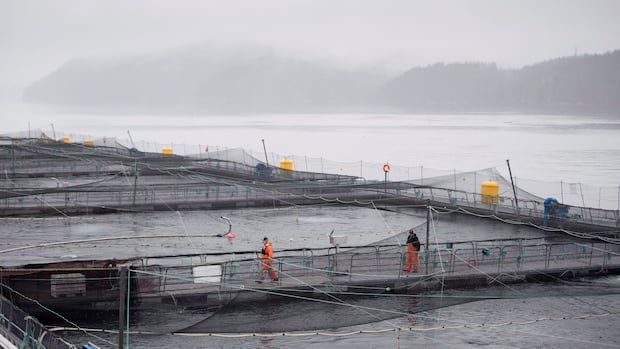

A recent study by the Pacific Salmon Foundation reveals that viral heart disease, known as heart and skeletal muscle inflammation (HSMI), is more prevalent in open-net salmon farms in British Columbia than previously acknowledged. The study, published in the Aquaculture journal, identified HSMI in five out of seven open-net pen salmon farms located in the Broughton Archipelago, east of Port McNeill on Vancouver Island. Researchers warn that the disease-causing virus, piscine orthoreovirus (PRV), can spread to wild fish in the surrounding waters.
Lead author Emiliano Di Cicco stated that the prevalence of the disease is significantly higher than initially believed based on their findings. A previous study in 2017, conducted by Di Cicco and colleagues, discovered the disease in one out of four farms examined at that time, indicating that it was not an isolated incident.
The Department of Fisheries and Oceans (DFO) in British Columbia currently classifies PRV as non-pathogenic, despite evidence linking it to HSMI. Di Cicco urges the federal government to reclassify the virus as pathogenic and align diagnostic criteria with global standards. He argues that the current diagnostic approach used by DFO may overlook cases due to its reliance on observable symptoms or significant mortality rates, while globally, HSMI is recognized as a chronic, low-level condition.
DFO has pledged to review the study’s findings for future considerations. The B.C. Salmon Farmers Association has not yet responded to requests for comments but has previously dismissed concerns about PRV, labeling them as “fearmongering.” Industry groups emphasize the economic importance of salmon farming in British Columbia, citing its contribution to highly skilled jobs and the majority share of Canada’s salmon production.
The study, conducted in collaboration with the Mamalilikulla, ʼNa̱mǥis, and Ḵwiḵwa̱sut’inux̱w Ha̱xwa’mis First Nations, highlights the long-standing reliance of Indigenous communities on salmon. Chiefs from Indigenous nations expressed gratitude for the scientific validation of their concerns regarding the impact of open-net salmon farms on salmon populations and the environment.