
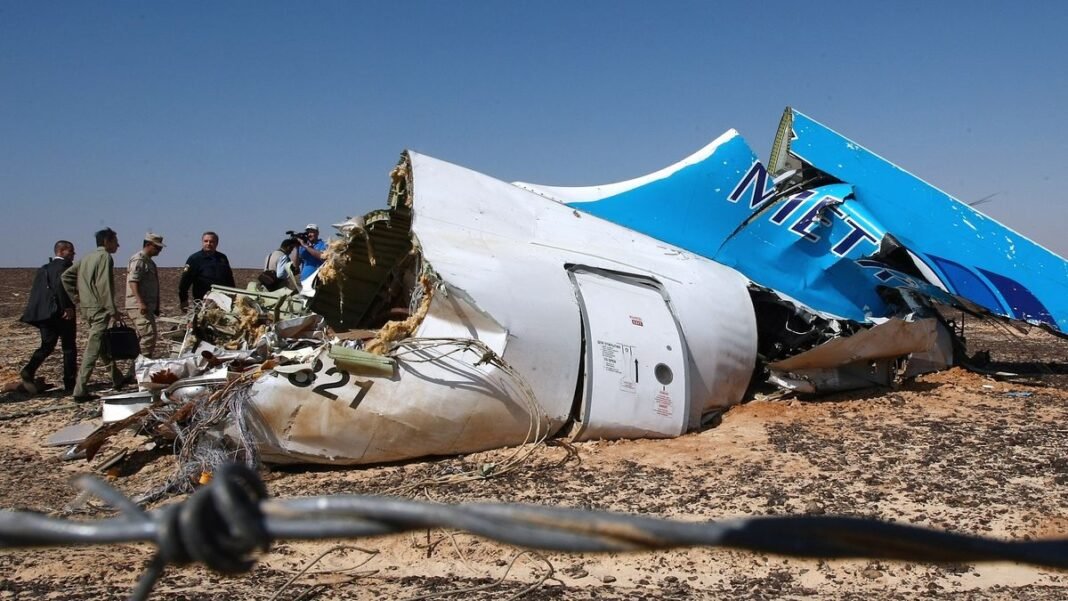

A routine flight departing from a popular vacation destination turned into a tragic incident for 224 passengers, including families, when the plane crashed shortly after takeoff. The fatal crash of Metrojet Flight 9268 occurred on October 31, 2015, as the aircraft ascended from Egypt’s Sharm el-Sheikh airport bound for Russia. Within 23 minutes of flight and at an altitude of 31,000ft, the Airbus A321 exploded in mid-air, leading to a catastrophic outcome.
The sudden explosion caused the plane’s rear fuselage to be torn apart, resulting in an uncontrollable descent that culminated in a crash in the Sinai desert. All individuals on board, comprising 25 children, seven crew members, 212 Russians, four Ukrainians, and one Belarusian, lost their lives in the tragic event. Most passengers succumbed to severe barotrauma during the flight due to the rapid air pressure change, making identification of victims challenging.
Following the disaster, various theories were proposed to explain the crash, including terrorism as a probable cause. Reports emerged indicating technical issues reported by the pilot during takeoff, although Egyptian aviation authorities denied the existence of distress calls. Concerns were raised about the potential involvement of individuals carrying an explosive device onto the aircraft, possibly orchestrated by terrorists.
While ISIS claimed responsibility for the incident, alleging an online explanation of their actions, Egyptian authorities did not confirm it as a deliberate attack. Despite extensive investigations, the exact reason behind the crash remained undisclosed. However, veteran aviation expert Julian Bray suggested that the disaster indicated a terrorist act involving a concealed bomb. Bray highlighted signs of an explosion within the plane, supporting the theory of an onboard explosive device.
Julian Bray speculated that terrorists likely used TNT hidden in luggage loaded onto the plane at the last minute to execute the attack. He emphasized the potential damage inflicted by a small bomb, capable of disrupting fuel lines, electrical systems, and igniting fires. The expert also proposed different methods through which the terrorists could have triggered the bomb during the flight, such as using a mobile phone or a timing device.