
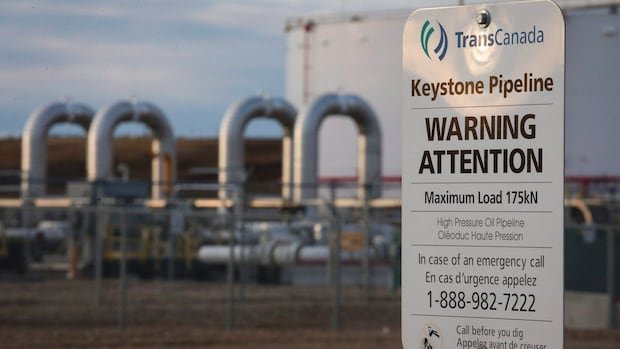

U.S. President Donald Trump has announced the potential revival of a controversial oil pipeline project as negotiations between Canada and the United States progress to avoid new U.S. tariffs on Canadian goods. Trump expressed on his Truth Social platform that the once-cancelled Keystone XL Pipeline could be resurrected. He even shared an AI-generated image depicting him lifting a large pipeline labeled “KEYSTONE” from a grave, with American flags waving in the background and a headstone reading, “Buried by Biden.”
While Canada has not officially responded to Trump’s statement regarding the project’s revival within the ongoing trade discussions, Washington has declared a temporary halt on planned 50 per cent tariffs on various Canadian goods for three days to facilitate further negotiations.
The history of the Keystone XL expansion dates back to July 2008 when the project was first proposed during the tenure of Prime Minister Stephen Harper and U.S. President George W. Bush. Subsequently, in March 2010, the National Energy Board approved TransCanada’s application for the Keystone XL extension with specific conditions related to safety and environmental protection. Over the years, the project faced opposition and hurdles, including protests and legal challenges, leading to its ultimate rejection by President Barack Obama in November 2015.
Following Trump’s election victory in November 2016, he signed an executive order in January 2017 to approve Keystone XL, initiating a series of legal and regulatory actions that have shaped the project’s trajectory. Despite ongoing controversies and setbacks, Trump’s second term as president in 2025 saw renewed interest in the pipeline project, with discussions between Canadian officials and Trump hinting at potential advancements.
In April 2026, Trump authorized a proposed project to transport Canadian oil across the border, aiming to revive portions of the Keystone XL pipeline. This move comes amidst a changing landscape surrounding the project, with South Bow, the Canadian company behind Keystone XL, collaborating with Bridger Pipeline in the endeavor.
As discussions and developments unfold, the future of the Keystone XL project remains uncertain, with stakeholders navigating a complex web of regulatory, legal, and environmental considerations.