
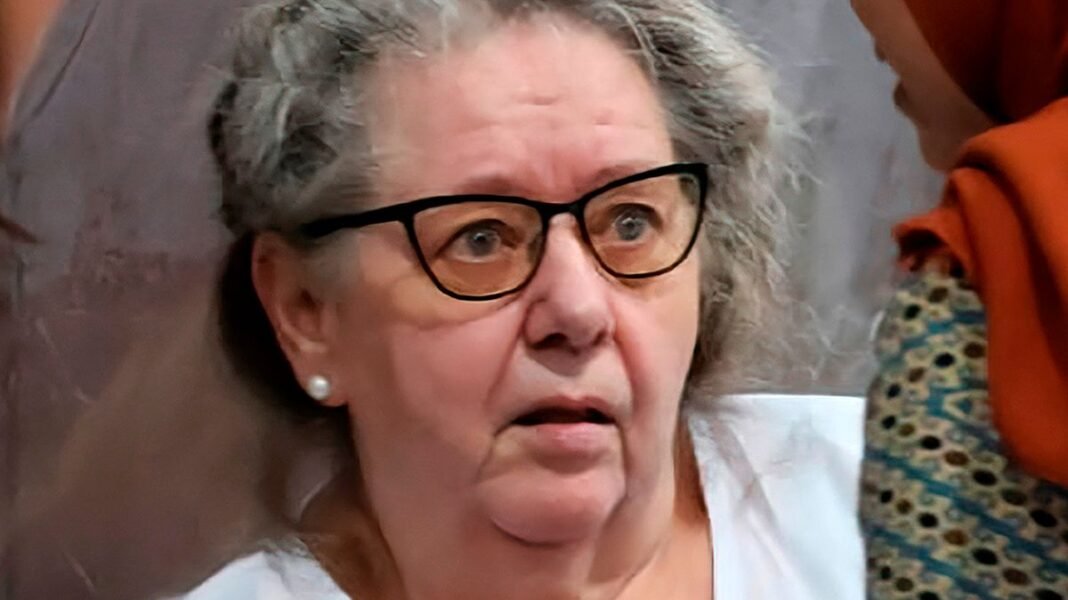

For over ten years, Lindsay Sandiford has been held in an austere prison in Bali. Now, she is embarking on a new chapter in her life, eagerly anticipating precious moments with her family. However, a former prison officer has pointed out that there may be obstacles awaiting her.
Lindsay, aged 69, was sentenced to death in 2013 for smuggling 1.6 million worth of cocaine into Indonesia while traveling from Bangkok to Bali. She claimed she was coerced by a UK drug syndicate, threatening to harm one of her sons if she did not comply with their demands.
Despite assisting the police in apprehending higher-ranking individuals in the syndicate, she was sentenced to death by firing squad under Indonesia’s stringent drug laws. Her time since then has been characterized by fear and uncertainty, confined within the walls of the infamous Kerobokan Prison, sharing a small cell with four other women. With a vast distance separating her from her family in Britain, it seemed she might spend the rest of her life in ‘Hotel K’.
The situation changed last month when a bilateral agreement was reached between Indonesia and the UK Government to secure Lindsay’s release, acknowledging her deteriorating health. Sources reveal that Prime Minister Keir Starmer and Home Secretary Yvette Cooper personally appealed to Indonesian authorities for her return. Lindsay, a former legal secretary, is eager to reunite with her loved ones and leave this harrowing chapter behind. However, what lies ahead for her?
A source disclosed to the Mirror: “Medical assessments have revealed Lindsay’s serious illness. After spending twelve years in one of the harshest prisons globally, the toll on her health is evident. She is anxiously looking forward to returning home and has been preparing for this moment for months. Before departing prison, she bid farewell to her fellow inmates, who had become like family to her.”
There is hope that Lindsay, who uses a wheelchair, will now receive the necessary medical treatment in the UK. Pastor Christine Buckingham, who recently visited Lindsay in Kerobokan jail, expressed, “She is in extremely poor health and is eager to reunite with her family after these 13 years. She longs to return home and enjoy some comforts.”
“We are immensely thankful to the Indonesian Government and the British Government for collaborating on this. We are anticipating her homecoming. Her health is the top priority. She needs thorough medical evaluation, and the plan is for her to spend quality time with her family,” Ms. Buckingham added.
Although Lindsay, originally from Redcar, Yorkshire, has been allowed to return to the UK on compassionate grounds, this does not guarantee her freedom. It is possible that she may be immediately transferred to a UK prison, posing its own set of challenges.
When questioned about Lindsay’s future in Britain, Indonesia’s deputy minister for immigration and correctional coordination, I Nyoman Gede Surya Mataram, stated, “In England, she will be incarcerated.” The UK’s Foreign Office has not yet confirmed or refuted Mataram’s assertion.
Considering the potential scenario of Lindsay being incarcerated once more, this time under different circumstances, former prison officer Hannah M remarked, “I imagine the rigid routines and strict regimes of UK prisons will be overwhelmingly different for her after years in an environment where survival required sheer instinct and strength.”
She continued, “She is likely to experience significant emotional and social upheaval, feeling like she is re-entering a world that has moved on without her. I am concerned that she may be perceived as a ‘celebrity’ within the prison walls, which, although seemingly positive from an external viewpoint, can lead to bullying, exploitation, and extortion internally, particularly given her fragile physical health – making her an easy target.”
In 2012, Lindsay relocated to India after being evicted from her residence in Cheltenham, Gloucestershire. It remains unclear where she will reside should she avoid further imprisonment.
In addition to the physical challenges Lindsay must navigate, she will also have to confront the mental toll of her years at Kerobokan Prison, likely leaving her with significant psychological scars, as warned by former prison officer Hannah.
Having extensive experience in criminal justice, Hannah elaborated, “The transition from somewhere like Kerobokan Prison to a UK prison is so drastic that it’s difficult to articulate. She is moving from years on death row in a brutal, unregulated, highly corrupted environment where survival often meant relying solely on oneself, to a highly controlled and regulated English system where every aspect of life is regimented. Though this may not sound traumatic, living through it can be extremely distressing.”
Hannah, who previously collaborated with a charity aiding recently released prisoners, added, “There is a high likelihood that she will struggle profoundly with her mental health – potentially facing severe psychological trauma such as PTSD and finding it challenging to trust individuals in authority, given the circumstances where a different nation’s authorities sentenced her to death and subjected her