
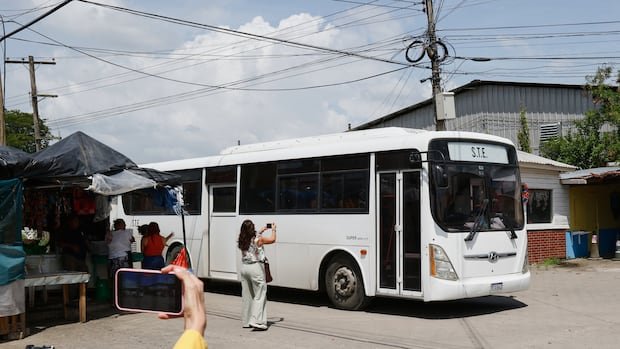

The U.S. has expelled close to 2,300 Mexican nationals to Guatemala and sent a smaller number to Honduras this year, as per official figures. This marks a shift from the early part of President Donald Trump’s second term when such deportations were rare. Previously, only a few Mexicans were sent to countries other than Mexico, in adherence to non-refoulement principles in both U.S. immigration law and international treaties. Non-refoulement prohibits sending migrants back to countries where their rights or safety could be at risk.
Mexico’s National Migration Institute (INM) confirmed that Mexicans have been deported by the Trump administration to Guatemala and Honduras, predominantly since April, and then transported by bus to southern Mexico. The Mexican government has voiced its objection to this practice, emphasizing that every Mexican citizen has the right to enter the U.S.
Tensions have arisen between Mexico and the U.S. due to the influx of migrants. President Claudia Sheinbaum’s administration has protested the deaths of 17 Mexicans in U.S. immigration custody. The U.S. Department of Homeland Security stated that it is leveraging all legal means to execute a significant deportation operation, as promised by President Trump.
Guatemalan President Bernardo Arévalo disclosed that 2,284 Mexicans deported from the U.S. have transited through Guatemala before being returned to Mexico under an agreement with the Mexican government, without the deportees having refugee or asylum status. In Honduras, 82 Mexicans arrived on flights in mid-August, with an additional 35 arriving later. According to Third Country Deportation Watch, 165 Mexicans were deported to Honduras between May and mid-July.
It is believed that the U.S. is using third-country deportations as a tactic to indirectly pressure asylum seekers to return to Mexico due to court restrictions on direct deportations. Agreements with several countries have been made to act as transit points for migrants expelled from the U.S.
In a separate development, the U.S. deported individuals to Haiti for the first time post a Supreme Court ruling allowing the termination of the temporary protected status (TPS) program for Haitians. A legal battle victory enabled the U.S. to proceed with deportations to Haiti and implement an agreement with Liberia for accepting non-citizens.
Concerns have been raised regarding the safety and resources in Haiti for those being deported, citing high levels of violence, poverty, and other challenges. Liberia welcomed deportees from various regions, offering them the option to seek asylum. The U.S. State Department reiterated its commitment to combat illegal immigration and enhance border security.