
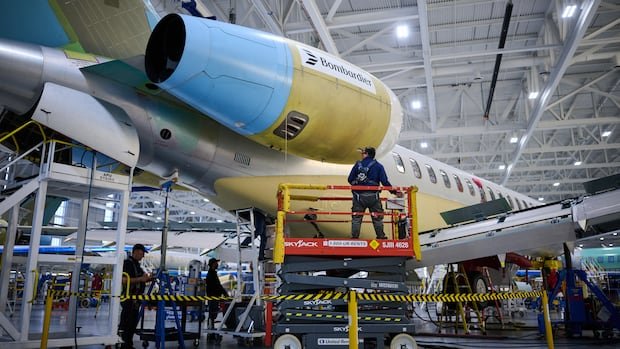

U.S. President Donald Trump announced on Monday that Bombardier, a Montreal-based aircraft manufacturer, will no longer be permitted to sell its products in the United States unless it begins production within the country.
In a post on Truth Social, Trump stated, “NO MORE SELLING BOMBARDIER IN THE UNITED STATES! Their products do not meet our standards! If they wish to access our market, they must establish manufacturing facilities here and cease treating America as a mere ‘piggybank’.”
This declaration by Trump, amid escalating trade tensions between Washington and Ottawa, is part of his ongoing efforts to urge both foreign and domestic companies to increase manufacturing activities within the U.S.
This push for domestic production has been a key focus of Trump’s economic policies in his current term, including the implementation of a comprehensive tariff strategy that has faced criticism from various U.S. trade partners. Canada is poised to enforce retaliatory tariffs against the United States starting early Tuesday.
Responding to Trump’s remarks, Quebec Premier Christine Fréchette emphasized the significance of Bombardier to Quebec’s economy and the aerospace industry. She described Bombardier as a source of pride for the region and extended her support to Bombardier’s CEO, Eric Martel.
The White House has not yet provided details on how Trump intends to enforce the directive against Bombardier or prevent the delivery of approved Bombardier jets by the U.S. Federal Aviation Administration (FAA). It is worth noting that Bombardier’s jets comply with the terms of the Canada-United States-Mexico Agreement (CUSMA), a trade deal supported by Trump.
Although Bombardier already has manufacturing operations in the U.S., U.S. aerospace analyst Richard Aboulafia expressed skepticism about the feasibility of halting Bombardier jet sales. He pointed out that many of Bombardier’s private jets use engines from U.S. manufacturers like Honeywell Aerospace and GE Aerospace.
Bombardier, a competitor of U.S.-based Gulfstream Aerospace, maintains a substantial presence in the U.S. with thousands of employees and suppliers, along with production facilities and service centers. The company has plans to expand its U.S. operations further, including the establishment of a new service center and wing production for its Global 8000 jet in Texas.
In past interactions, Trump had threatened import tariffs on Canadian aircraft, but those measures did not materialize. Bombardier recently announced its acquisition of a Canadian factory from Mitsubishi Heavy Industries to enhance its aircraft wing production.
John Gradek, a supply chain networks and aviation management expert at McGill University, cautioned that targeting Bombardier could have unintended consequences for both U.S. citizens and the company’s American workforce. He predicts that Bombardier may just be the first of several Canadian companies to face similar actions in the ongoing trade dispute.
The situation remains dynamic, with uncertainties surrounding the potential impact of Trump’s stance on Bombardier and the broader implications for the aerospace industry.
[End of Rewritten Article]