
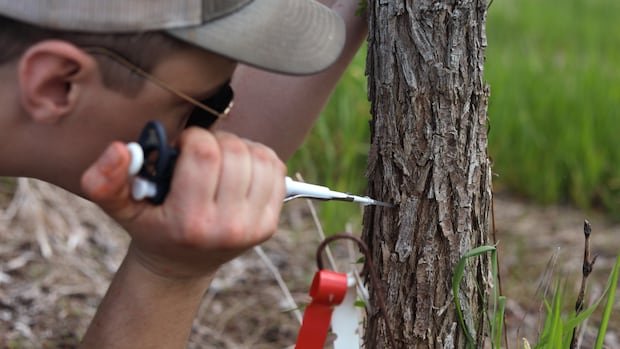

Over the summer, scientists in Vermont have been intentionally infecting thousands of trees with Dutch elm disease. The goal of this unusual experiment, conducted by researchers from the U.S. Forest Service and the Nature Conservancy, is to test the resistance of a new generation of elms bred from disease survivors. The devastating impact of the disease on elm populations in the U.S. and Canada has prompted this initiative in hopes of eventually restoring the once abundant elm trees that lined streets and adorned river banks.
Gus Goodwin, a senior conservation planner at The Nature Conservancy, expressed the profound loss caused by the decline of elm trees over the years. The experiment in Vermont aims to potentially develop a strain of elms that are impervious to Dutch elm disease (DED), offering hope for a solution to combat the disease’s spread in new regions.
Similar efforts to enhance DED resistance are underway in Canada, where the University of Guelph operates the Elm Recovery Project. Alison Morrison, a project manager at the arboretum, emphasized the importance of preserving elms’ ability to withstand the disease, emphasizing the significance of maintaining the elm population’s resilience.
The Decline of Elm Trees in Fredericton
Once dubbed the “City of Stately Elms,” Fredericton in eastern Canada witnessed a sharp decline in its elm tree population during the 1960s and 70s due to Dutch elm disease. The loss of an estimated 10,000 trees has reduced the once abundant elm presence to only around 1,000 mature trees. Anthony Taylor, a forest management professor at the University of New Brunswick, noted the ongoing challenges faced by surviving elms as they battle successive waves of the disease.
When elm trees are infected by bark beetles carrying DED spores, the disease attacks their vascular system, disrupting water flow and ultimately leading to the trees’ demise within a few years. To prevent further spread, infected elms are promptly removed. In the past, healthy nearby elms were also removed in a process called “sanitization,” inadvertently impacting the population’s resilience against DED.
Challenges Facing Elm-Lined Streets
Elm trees have faced a resurgence of Dutch elm disease in various regions, including Edmonton and Saskatoon, where infected trees have been identified in recent years. Efforts to combat the disease involve swift removal of infected trees and community adherence to measures aimed at curbing its spread, such as refraining from pruning elms during specific periods.
While the disease poses a significant threat to urban forests, the loss of mature elm trees hinders their environmental benefits, such as providing shade and aiding in stormwater management. Reintroducing disease-resistant elms into communities could enhance ecosystem diversity and resilience, offering a potential solution to mitigate the impacts of climate change.
Pursuing Disease-Resistant Elm Trees
Researchers in North America, including those at the Elm Recovery Project and in Fredericton, are focused on developing elm trees resilient to DED through breeding and cloning programs. The long-term goal is to establish a generation of disease-resistant elms capable of coexisting with the disease, much like European elms. While the process of breeding and testing resistant trees is time-consuming, it holds promise for restoring elm populations and enhancing their survival against Dutch elm disease.
Initiatives such as the Vermont experiment, involving the deliberate infection of thousands of trees with DED spores, aim to identify and propagate disease-resistant elms on a larger scale. The collaborative efforts of scientists and foresters underscore the importance of bolstering elm tree resilience to combat the persistent threat of Dutch elm disease.
Tag: rewrite-pending