
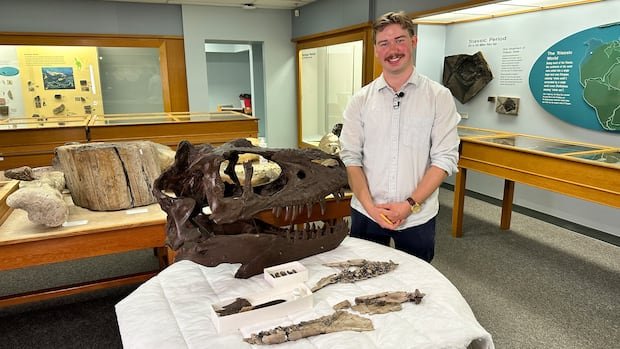

Researchers from the University of Alberta have uncovered a fascinating revelation that suggests a raptor dinosaur may have preyed upon a larger tyrannosaur. The discovery was made when bite marks were found on the jaw of an eight-year-old Albertosaurus, a relative of the well-known Tyrannosaurus rex that inhabited Alberta around 70 million years ago.
The presence of the bite marks led the researchers to consider two possible scenarios regarding the fate of the young Albertosaurus. The prevailing theory suggests that a smaller raptor, a carnivorous, two-legged dinosaur, may have consumed the larger Albertosaurus after its demise near Drumheller, Alberta.
Philip Currie, a professor of dinosaur paleobiology at the University of Alberta, emphasized the significance of this find, stating that it provides rare insights into carnivorous dinosaurs’ interactions and the complexities of the prehistoric food chain. The research, led by Joshua Doyon, a master’s student in paleontology at the university, analyzed the spacing between the bite marks to conclude that a raptor was the probable culprit.
The alternative hypothesis proposed that the Albertosaurus could have been cannibalized by a much younger member of its own species, an individual less than two years old and approximately two meters in length. The discovery of the fossil in 2022 by a member of the public exploring the badlands near Drumheller led to further investigation and research efforts in 2023.
Currie highlighted the importance of scrutinizing detailed features on fossils to gain insights into dinosaur biology and ecosystem dynamics. The tooth marks on the Albertosaurus specimen offer valuable information on ancient feeding behaviors and predator-prey interactions, shedding light on how different species coexisted in prehistoric times.
The finding is significant as it provides rare evidence of one carnivorous dinosaur feeding on another, rather than on herbivorous prey. The smaller raptors in Alberta, belonging to a group known as dromaeosaurs, were notably smaller than their Hollywood depictions in films like Jurassic Park. Doyon expressed hope that future discoveries of dinosaur fossils will pay attention to subtle tooth marks, offering further clues into ancient ecosystems.