
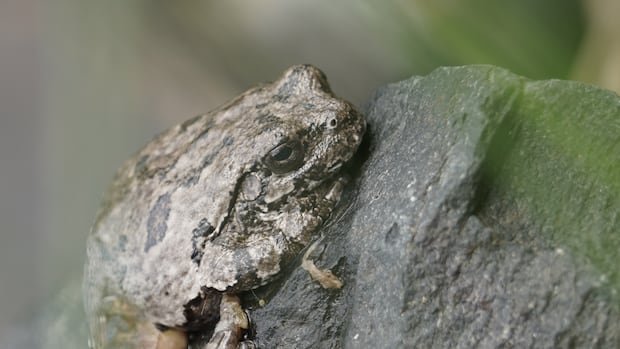

Thickening skin peeling off lethargic frogs and toads in patches. Struggles with respiration and feeding. A compromised immune system causing bodily shutdown.
These are recognizable symptoms of chytridiomycosis, a fatal fungal infection known as an “epidermal epidemic” that has led to the extinction of numerous amphibian species globally.
Although not yet identified in the central province of Canada, Manitoba, the absence of detection does not necessarily mean the disease is absent.
“It is literally present everywhere on our continent… There’s no doubt that this pathogen is here,” remarked Jackie Tran, a graduate student conducting frog and salamander sampling throughout southern Manitoba.
Chytrid affecting frogs is caused by the fungal pathogen Batrachochytrium dendrobatidis, while in salamanders, it is caused by Batrachochytrium salamandrivorans.
The latter, thought to have originated in East Asia, emerged in the last few decades and has significantly reduced local salamander populations in parts of Europe. However, it has not yet crossed over to North America, as far as scientists are aware.
The exact origins of the variety infecting frogs and toads remain unclear, although indications suggest its presence in Brazil and Asia for well over a century before appearing globally, largely due to the exotic pet trade.
Chytrid has been directly linked to the extinction of at least 90 species and a decline in numbers of over 500 others, earning it the title of “the worst infectious disease ever recorded among vertebrates.” Its prevalence has increased in the U.S. and Canada in recent years.
Nearly half of the frog populations in Alberta sampled between 2006-2010 tested positive for chytrid. Concurrent studies in British Columbia during the same period found its presence in one out of every ten amphibians sampled, with northern leopard frogs being particularly affected.
The northern leopard frog, federally listed as endangered in parts of Western Canada and of special concern in Manitoba, has experienced population declines across the country in recent decades. Suspicions linger that chytrid may have been responsible for a significant drop in Manitoba numbers five decades ago.
Tran’s research, focusing on confirming the presence of the deadly fungal pathogen in Manitoba’s amphibian populations, marks the beginning of a proactive monitoring initiative at Brandon University that his supervisor intends to continue.
Experts warn that with environmental and climate changes, the risk to amphibians in the Prairies could potentially escalate.
“If we can stay ahead of this, it could help mitigate some of these declines,” emphasized Pamela Rutherford, an associate professor at Brandon University.
Pathogens thrive in wetlands degraded by human activities, making Tran’s identification of such habitats valuable beyond his project, providing insights into overall wetland health and its broader ecological implications.
Confirmation of the pathogen in Manitoba amphibians by Brandon researchers offers hope that these species may not be doomed to extinction. Previous field experiments have shown promising results in inoculating young leopard frogs against the effects of chytrid, hinting at potential strategies to aid affected populations.