
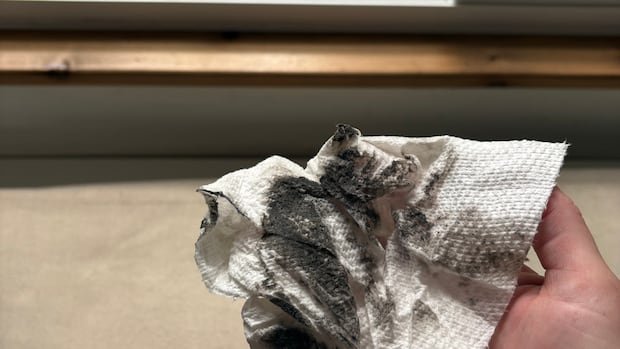

A research team based in Hamilton has uncovered insights into the issue of soot accumulation in neighborhoods surrounding the city’s industrial zone. Residents have long voiced concerns about a dark, dirty residue covering their properties, with recent complaints peaking in early July due to what some described as unprecedented fallout.
Sarah Styler, an environmental chemistry associate professor at McMaster University, and Grace Yao, a PhD candidate in Styler’s lab, are involved in a project titled “What’s the Grime?” aimed at addressing this matter. Through collaboration with volunteers who gathered samples across the city in 2024 and 2025, the researchers discovered that the soot contains harmful substances consistent with coal burning. Moreover, they observed elevated levels of dust and polycyclic aromatic hydrocarbons (PAHs) in proximity to the industrial sector in northeast Hamilton.
Styler collaborated with Environment Hamilton on this study, supported by a $15,000 university grant awarded in 2024. Both residing in areas affected by the soot, Styler in east Hamilton and Yao in Corktown, they emphasized the long-standing nature of this issue, with historical references dating back to the 1950s.
The investigation involved the deployment of sampling kits to collect soot from the homes of 50 volunteers across the city. Samples were taken from each kit every four months for analysis. The team found that more dust and toxic compounds are present closer to the industrial sector, indicating a correlation between industrial activities and the pollutants.
Despite resource constraints limiting the scope of the study to only certain compounds, Yao noted the significant contribution of coal combustion to the identified PAHs. While the team refrained from pinpointing specific industrial sources, they expressed the potential for further research to provide more insights with enhanced monitoring capabilities.
Styler highlighted that the findings may not be surprising to residents in the affected neighborhoods, suggesting an association between the soot and industrial emissions. However, the lack of information from official sources has left locals frustrated, prompting ongoing testing by the Ministry of the Environment, Conservation and Parks to determine the source of the pollutants.
The researchers are planning a community meeting on August 20 to present their findings and intend to expand the study to include 200 volunteers for a more comprehensive analysis of the grime. They also aim to delve into effective cleaning methods for the residue.