
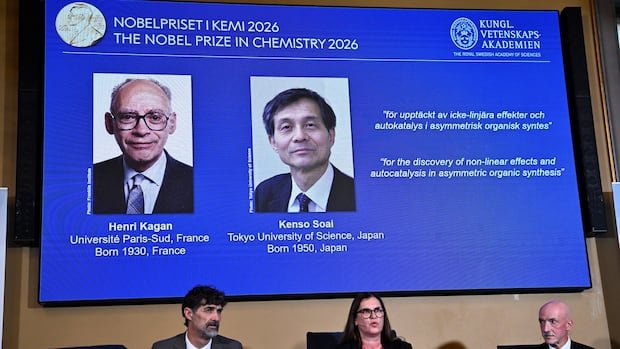

Henri B. Kagan and Kenso Soai were awarded the Nobel Prize in Chemistry for their groundbreaking research on non-linear effects and autocatalysis in asymmetric organic synthesis. The Nobel Committee for Chemistry praised their work in unraveling the mystery of homochirality, a phenomenon that has perplexed scientists for more than a century. These discoveries have significantly impacted the development of chemical reactions used in pharmaceutical manufacturing.
Kagan, a 95-year-old French national affiliated with Université Paris-Saclay, and Soai, a Japanese researcher born in 1950 conducting studies at the Tokyo University of Science, were announced as the laureates by the Royal Swedish Academy of Sciences in Stockholm. The prestigious award comes with a prize of 12 million Swedish crowns ($1.7 million Cdn) to be shared between the two scientists.
Their research focused on the emergence of homochirality in chemical reactions, where molecules exist as mirror images of each other but living organisms predominantly utilize only one form. Kagan and Soai’s innovative methods in directing reactions to produce specific mirror-image structures have revolutionized the field of pharmaceutical chemistry.
Expressing his excitement, Soai shared that receiving the news was one of the most thrilling moments of his life. He recounted being informed by the Nobel committee while out shopping near his residence. The Nobel Prize in Literature is scheduled to be announced on Thursday, followed by the peace prize on Friday, and the economics prize on October 12.
The Nobel laureates will officially receive their awards on December 10, the date of Alfred Nobel’s passing. In his will, Nobel stipulated that his estate should be used to recognize individuals who have made significant contributions benefiting humanity.