
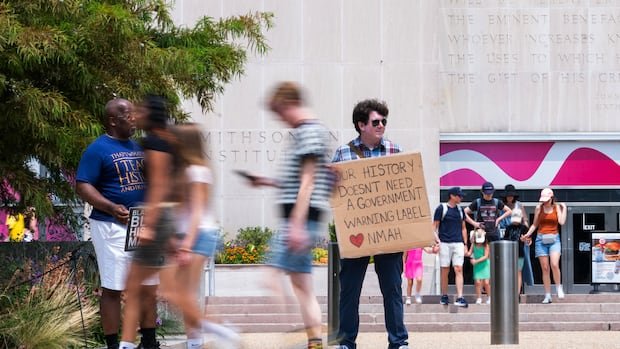

The Smithsonian’s National Museum of American History in Washington, D.C., attracts visitors globally, showcasing iconic artifacts like Dorothy’s ruby slippers from the “Wizard of Oz” and inaugural gowns worn by U.S. first ladies. However, recent gatherings outside the museum have seen protesters holding signs advocating for truth in history representation. The museum is currently amid an initiative by the Trump administration to influence the narratives presented by cultural institutions in the United States.
Suse Anderson, a museum studies expert at George Washington University, highlighted the administration’s efforts to align exhibits with conservative values and diminish the influence of independent experts. President Donald Trump directed the placement of signs cautioning visitors about alleged inaccuracies within the museum, referencing a White House report released on America’s 250th anniversary.
The Smithsonian, comprising 21 museums and 14 research centers, houses over 150 million artifacts, including historical items and artworks. The recent report accused the National Museum of American History of emphasizing negative aspects of American history, such as slavery, Indigenous issues, and gender fluidity, prompting concerns about political influence over museum content.
In response, museum director Anthea Hartig defended the institution’s commitment to presenting a comprehensive narrative of American history. Despite external pressures, the Smithsonian has stood firm, emphasizing the importance of scholarly accuracy and telling the complete story of America.
Critics, including history professor James Millward, view the administration’s actions as a move to reshape the Smithsonian’s direction and potentially stack its leadership with sympathetic members. Concerns also arise about broader implications, with some viewing the attacks on the Smithsonian as part of a larger agenda to redefine American identity and history.
Amidst the ongoing debate, the Smithsonian’s reputation as a trusted institution remains strong, with polls consistently showing high levels of public trust in museums. While differing opinions exist on content inclusion, the majority of Americans support curatorial independence for institutions like the Smithsonian.
As visitors exit the museum, diverse perspectives emerge regarding the portrayal of American history. While some find the exhibits enlightening but politically skewed, others appreciate the diversity of narratives presented, acknowledging the complexity of American history and the importance of understanding both its positive and negative aspects.