

Fossil eggshells from some of the largest dinosaurs ever discovered have been unearthed in a surprisingly cool climate located far from the equator. Despite their enormous size, the titanosaurs could not rely on brooding to keep their volleyball-sized eggs warm.
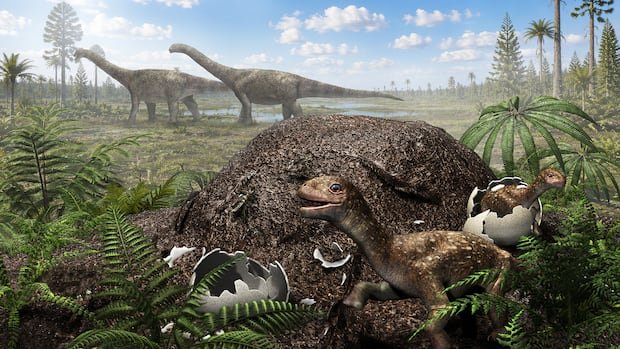
A recent study conducted by University of Calgary paleontologist Darla Zelenitsky and researchers from Japan and Argentina delves into the microscopic details of how titanosaurs managed to maintain the ideal egg incubation temperature without physically sitting on their nests. By closely examining the tiny pores on the eggshells, the team suggests that titanosaurs likely employed a method similar to modern crocodiles – burying their eggs in warm mounds of decaying vegetation.
Titanosaurs were colossal, herbivorous dinosaurs with long necks and tails that roamed on four legs, reaching weights of up to 75 tonnes, comparable to half the mass of a blue whale. Fossilized volleyball-sized eggs associated with titanosaurs, known as Fusioolithus, were previously abundant in warmer climates but were also discovered in the Chorrillo Formation in southern Argentina dating back to the Late Cretaceous period.
The Chorrillo Formation, with a climate akin to present-day New York City, once hosted diverse dinosaur species like the Nullotitan glaciaris and Isasicursor santacrucensis, along with crocodiles, birds, and various other fauna. The finding of titanosaur eggs in this region has astounded experts like Zelenitsky, emphasizing the challenges faced by larger animals in surviving and reproducing in such environments.
Dinosaurs needed to ensure their eggs remained warm for extended periods to allow embryos to develop and hatch successfully. While smaller dinosaurs could brood their eggs like birds, titanosaurs had to explore alternative methods due to their immense size. Sea turtles sunbathe their eggs on sandy beaches, a strategy unsuitable for the cooler Argentine climate. In contrast, titanosaurs likely buried their eggs in decaying plant matter to generate heat through microbial activity, as evidenced by the porous nature of the discovered eggshells.
This innovative incubation technique showcased the adaptability of dinosaurs, even the largest ones, to thrive in various environments. The study sheds light on the resourcefulness and evolutionary strategies employed by titanosaurs to ensure successful reproduction in different latitudes. Further research on titanosaurs’ nesting habits may provide additional insights into their global spread during the Late Cretaceous period.