
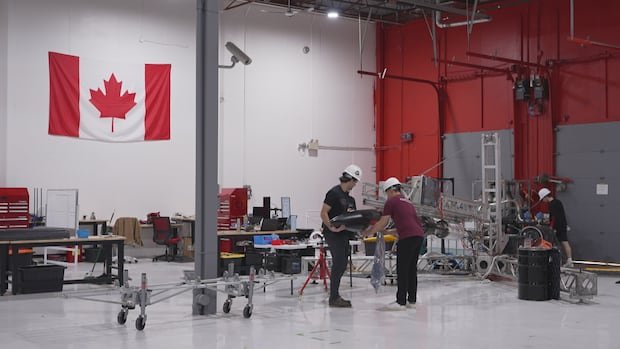

Canada, as the only G7 nation lacking its own rocket launch capabilities, is striving to establish a Canadian-made rocket. Several Canadian companies are in a race to provide the country with indigenous access to space, coinciding with concerns among some SpaceX clients about potential reduced launch services. The journey to achieve this goal is complex, involving high costs, tight deadlines, and shifting government priorities.
Due to the absence of domestic rocket launch capabilities, Canadian customers, including private firms and government entities, rely on external providers to deploy their satellites into orbit. Notably, SpaceX, which launched all 12 Canadian satellites in 2025, plays a significant role in this regard. These satellites serve crucial functions in telecommunications, military applications such as threat detection, and earth observation tasks like wildfire monitoring.
Marc Boucher, the founder of SpaceQ, underscores the importance of controlling Canadian launches to safeguard against potential foreign restrictions on launching Canadian technology. The Canadian government has recognized space as a key sovereign capability and introduced legislation to authorize launches from Canadian soil. Recent funding initiatives, including $8.3 million each for three Canadian rocket companies, aim to achieve light-lift rocket capabilities by 2028.
Among these companies is NordSpace, established in 2022, focusing on satellite and space technology development, including rockets and launch infrastructure. Despite an unsuccessful suborbital rocket test in 2025, NordSpace remains determined to try again soon. Another participant, Reaction Dynamics, is working on a unique engine design since 2017, with plans to reach orbit by 2028.
The newest entrant, Canada Rocket Company, aims to build a medium-lift rocket propelled by nine methalox-fueled engines. CEO Hugh Kolias, backed by private investments and government funding, is optimistic about achieving the goal by 2032. The company has hired top engineers and is constructing a $30 million test facility in London, Ontario, to support its endeavors.
As SpaceX transitions to its Starship rocket, concerns arise among clients reliant on its Falcon 9 rocket. The shift could impact smaller players utilizing SpaceX’s rideshare program, potentially limiting their access to space. Canadian companies like Canada Rocket Company see an opportunity to fill the void left by SpaceX’s Falcon 9 in the medium-lift rocket market.
While progress is promising, challenges persist in the long-term development of Canadian rocket capabilities. Companies like NordSpace are cautiously optimistic, emphasizing the need for sustained funding and support to overcome hurdles on the path to regular launches from Canada. The industry experts stress the significance of continued investments to ensure the success of Canada’s space ambitions.