
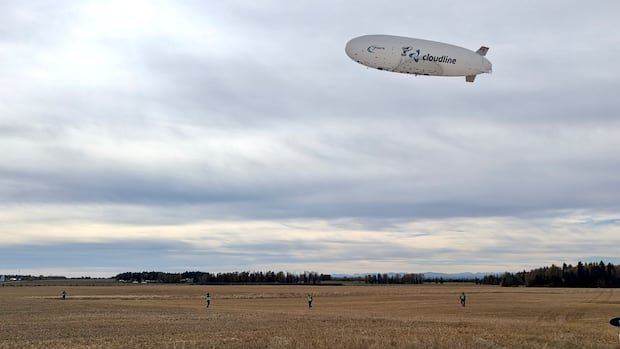

A unique aerial sighting in central Alberta last week caught the attention of onlookers, sparking curiosity about a massive 20-meter airship flying overhead. While a Goodyear Blimp might be a familiar sight at events, witnessing such an airship in rural Alberta is a rare occurrence.
The airship, powered by solar energy and comparable in size to a school bus, was engaged in testing a new method for gathering aerial survey data near Rocky Mountain House, approximately 200 kilometers southwest of Edmonton. The flight tests were conducted by a collaborative team consisting of Cloudline, a South African aerospace company that produced the airship, and its Canadian partner, 3 Points in Space Media.
According to Sean Adams, the CEO of 3 Points in Space Media, the airship operates similarly to a helium party balloon and represents an advancement in airship technology by integrating control systems to create an autonomous aircraft. The crew conducted trial runs with TC Energy to inspect pipeline routes in the area.
The airship’s pre-flight preparations involve filling its envelope with helium and conducting diagnostic assessments while it remains tethered. Once cleared, the aircraft is released for calibration flights before embarking on extensive survey missions. Adams mentioned that the airship, classified as a remotely piloted aircraft system, is equipped with automated flight controls, making it suitable for data collection in remote regions like monitoring pipelines and infrastructure.
Despite the advantages of airships in carrying heavier camera and LiDAR sensors over longer distances compared to standard drones, crewed aircraft still excel in handling severe weather conditions. The potential benefits of using airships for various data collection purposes were highlighted by Joe Zhou, TC Energy’s vice-president of pipeline integrity, who emphasized the quieter nature of the approach compared to traditional aircraft.
Michael Adams, the VP of research and development at 3 Points in Space Media, expressed enthusiasm for revitalizing airship technology, tracing its historical significance back to the era of commercial passenger air travel in the 1930s. He commemorated this legacy by attaching a piece of fabric from the Graf Zeppelin, a renowned airship that completed the first transatlantic passenger flight in 1928, to the airship’s payload.
Local residents of Rocky Mountain House were intrigued by the sight of the airship, with Mayor Shane Boniface remarking on the significant social media attention it garnered. While Cloudline operates airships in several countries worldwide, the presence of autonomous airships in Canadian airspace remains relatively uncommon. The next phase for the flight team involves cold-weather testing in northern Ontario to prepare the airship for operations in sub-zero temperatures and Arctic conditions.