
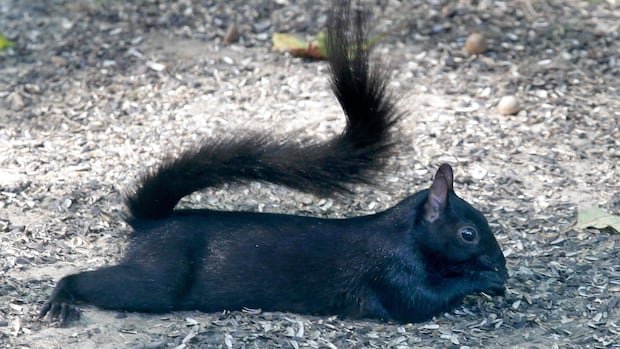

Francis Quang-Hai Dinh spent his first summer at McGill University exploring Montreal’s parks on his bicycle, tracking down squirrels. He visited nearly 200 green spaces, documenting over 800 grey and black squirrels. What began as a student assignment evolved into a personal project to understand how the city’s layout and waterways influence evolution quietly.
Dinh, who now studies integrative biology at the University of Illinois Urbana-Champaign, relied on his bike to reach various suburban areas where public transit options were limited. He became the sole researcher known to manually survey squirrels park by park in the region.
His research revealed that approximately 12% of squirrels in Montreal are black, with higher concentrations of black squirrels observed as he traveled northward. In areas just above Laval, up to 40% of squirrels had black coats. The study attributed this variation to temperature differences, as black squirrels can better absorb heat than their grey counterparts.
Additionally, forest cover played a role in the prevalence of black squirrels, as denser tree canopies provide better camouflage for them. The study’s focus was not solely on squirrels but on utilizing them as a model to explore how urban environments drive evolutionary changes.
According to Allison Roth, the study’s senior author and an assistant professor at the University of Missouri, Montreal’s unique urban landscape, segmented by waterways like the St. Lawrence River, creates fine-scale environmental differences that can lead to genetic adaptations in animal populations.
The study highlighted the intricate relationship between urbanization, temperature, vegetation structure, and wildlife adaptation. It emphasized that cities, while significant, are just one piece of the evolutionary puzzle, with various environmental factors shaping animal populations on a neighborhood level.
The research, titled “Fine-scale spatial variation in eastern grey squirrel melanism across a complex urban landscape,” provides valuable insights into how wildlife adapts to urbanization and will be featured in a special ecology journal edition. Dinh, reflecting on his experience, emphasized the coexistence of wildlife and urban environments, challenging the notion of nature and the city as separate entities.