
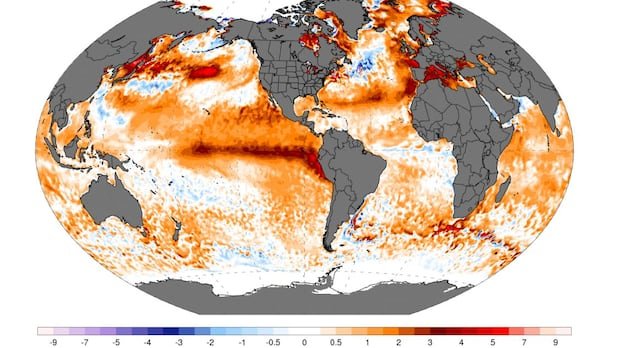

The highly anticipated El Niño has arrived and is already proving to be significant. Earlier this year, climate experts had predicted the development of an El Niño in the central Pacific region. Over time, more models started indicating a potentially strong or “super” El Niño, although it was cautioned that certainty was premature.
In June, the U.S. National Oceanic and Atmospheric Administration (NOAA) issued an El Niño advisory, confirming the presence of warmer conditions in the specified area of the Pacific Ocean known as Niño 3.4. For the designation of El Niño, temperatures in this zone must exceed the average by 0.5°C. Currently, ocean temperatures are around 2°C above average, marking a record high for this time of the year.
Climate scientist Zeke Hausfather from Berkeley Earth noted that temperatures in the Nino 3.4 region have surpassed 2°C, meeting the criteria for a very strong or even a “super” El Niño. This indicates early indications of a robust El Niño, even though it is only July.
El Niño and La Niña are part of the El Niño Southern Oscillation (ENSO) cycle in the Pacific Ocean. La Niña brings cooler temperatures, while El Niño brings warmer conditions. Forecasts suggest that the peak of this El Niño might occur in October, although many models predict a peak in November or December, signifying a prolonged period of potential impacts.
The last major El Niño occurred in 2015-2016, with an ocean temperature anomaly of about 2.75°C. The rapid transition from La Niña to El Niño this year has been notable, with experts highlighting the quick changeover within a single year. The possibility of a peak El Niño temperature exceeding historical records by a significant margin is being closely monitored.
Despite the uncertainties surrounding the influence of climate change on El Niño patterns, experts are vigilant about potential impacts, particularly concerning food security in tropical regions and the risk of wildfires in Western Canada due to expected milder temperatures and drier conditions. The potential ramifications of this El Niño underline the need for proactive measures to mitigate its effects on agriculture, ecosystems, and oceanic conditions.