

A wildfire researcher in Newfoundland, Lucas Brehaut, is facing challenges as various wildlife species disrupt his research efforts. Brehaut, a scientist with the Canadian Forest Service, is investigating forest regeneration post-wildfires in Atlantic Canada. Despite the region’s cool and wet climate, wildfires are becoming more frequent.
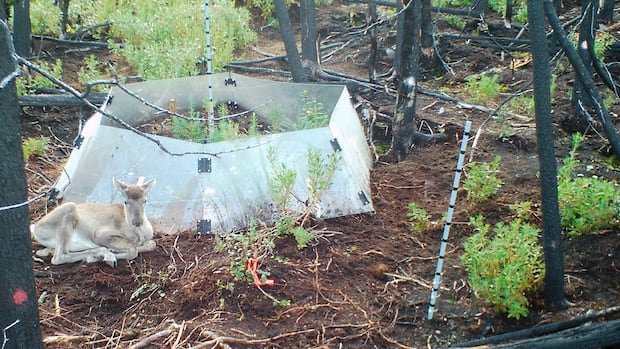
In response to a 2022 forest fire near Grand Falls-Windsor, N.L., Brehaut initiated a study to observe forest regrowth under changing climate conditions. He and his team installed 19 open-top chambers (OTCs) resembling mini greenhouses to monitor seedlings’ growth. These chambers simulate temperature changes caused by global warming, with the study currently in its third year out of five.
However, Brehaut encountered unexpected challenges in September 2023 when wildlife, including caribou, moose, black bears, wolves, rabbits, and owls, started interfering with his research equipment. Surveillance cameras installed for snow depth monitoring revealed the animals’ destructive behavior, leading to damage to 11 out of 19 sites, with some even stealing temperature sensors.
Despite these disruptions, Brehaut remains understanding, acknowledging that animals are simply exploring their habitat. Kaitlyn Gaynor, an assistant professor at the University of British Columbia, explains that animals’ curiosity towards new objects is natural, driven by the potential for food or perceived threats. She notes that bears, being omnivores, are particularly inquisitive about unfamiliar items.
Moreover, Gaynor emphasizes that human scent on research equipment can attract animals, suggesting measures to minimize disturbances. She shares experiences of animal interference during research in Africa, where baboons, hyenas, and elephants have caused equipment damage. Brehaut also mentions human interference, such as snowmobiles damaging research sites during winter in Newfoundland.
Despite these challenges, Brehaut remains committed to his research, acknowledging the delicate balance between studying nature and respecting wildlife’s interactions with scientific equipment.