
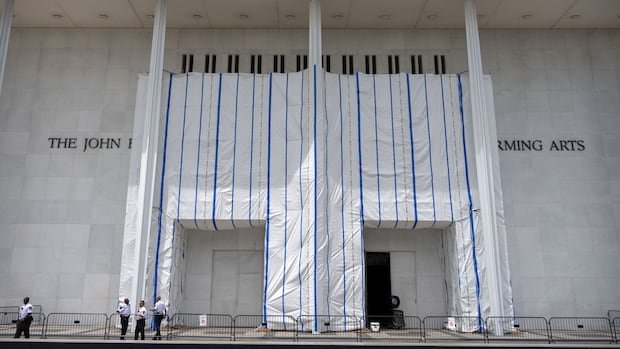

The dispute regarding the future of the Kennedy Center escalated on Thursday as allies of U.S. President Donald Trump on the board made moves to honor him by making physical alterations to the renowned performing arts venue, potentially defying a court order. In a lengthy virtual meeting, the board approved the addition of Trump’s name to the building’s facade, rebranding it as “The John F. Kennedy Center for the Performing Arts Restored and Renovated By President Donald J. Trump.” Additionally, the board proposed renaming the plaza in front of the building after Trump and initiating a two-year closure for extensive renovations.
These actions, as detailed by Representative Joyce Beatty, a Democratic board member from Ohio, and her legal team, represent a significant challenge to the ruling of U.S. District Judge Christopher Cooper. Cooper had previously deemed the addition of Trump’s name to the building as illegal and ordered its removal, a decision that the Trump administration unsuccessfully attempted to appeal. Moreover, Cooper had halted the planned two-year closure of the center, criticizing the board’s decision as uninformed and predetermined.
Beatty condemned the recent developments as an apparent effort to circumvent the court’s decision and violate congressional statutes. She vowed to continue advocating for the preservation of the historic monument. Notably, the Kennedy Center declined to provide immediate comments on the recent developments.
The board meeting primarily focused on determining the extent of closures necessary for the essential renovations to enhance safety at the Kennedy Center. In response to the judge’s concerns over the previous closure vote, the center’s leadership presented three potential options for consideration. These options ranged from a complete closure to phased closures focusing on critical infrastructure needs while maintaining programming.
Ultimately, the board decided on a two-year closure of the building, with the possibility of hosting limited programming in an outdoor space known as the Reach. This decision, alongside the efforts to honor Trump, may raise questions regarding the thorough consideration of alternative options by the board.
In recent years, the Kennedy Center has become emblematic of Trump’s influence as he reshapes Washington, D.C.’s physical landscape. Following his return to office, Trump swiftly replaced the center’s leadership with his allies and sought to leave his mark by adding his name to the building. Despite the temporary removal of his name due to legal challenges, Trump’s ambitious projects in the capital, including revamping the White House and other iconic structures, reflect his vision for transformation.
The Kennedy Center’s leadership asserts the urgent need for repairs and updates within the institution. Executives highlighted significant water damage and outdated equipment, emphasizing the necessity for comprehensive renovations. While legal battles and controversies surrounding the center persist, the institution remains dedicated to its mission of providing cultural enrichment for all Americans.
The Kennedy Center saga underscores the intersection of politics, culture, and preservation in the nation’s capital, encapsulating the ongoing debate over the legacy of public landmarks amidst changing political landscapes and legal challenges.