
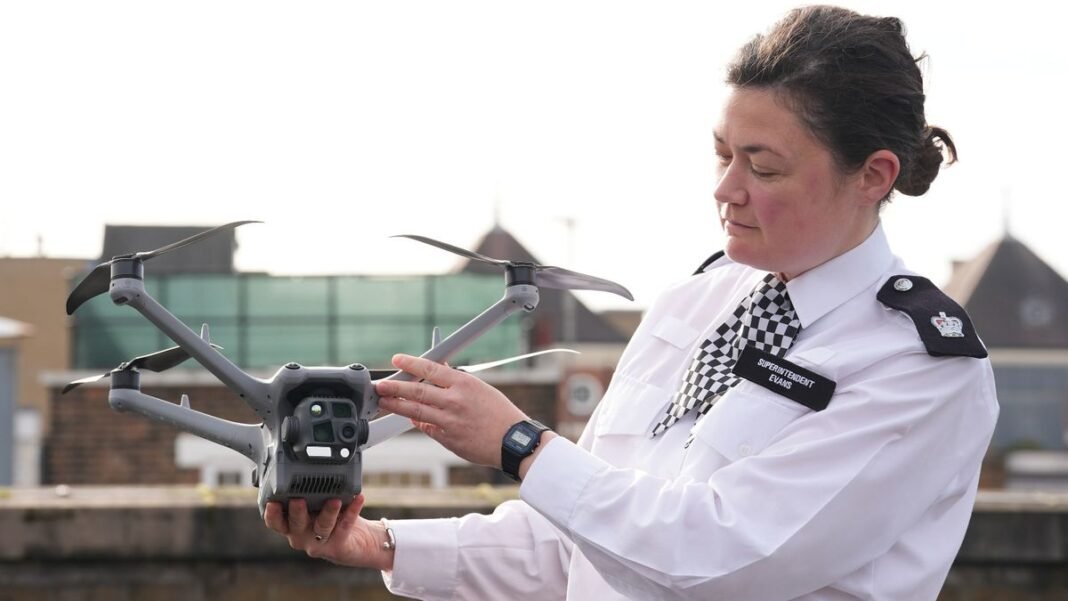

The Metropolitan Police is considering the use of drones to pursue suspects evading law enforcement. These remote-controlled drones, equipped with high-definition cameras, have been tested by Scotland Yard. They are designed to provide real-time intelligence to assist officers on the ground and in control rooms in apprehending suspects. Compared to helicopters, these drones are more cost-effective and easier for police to deploy, with the capability to reach a crime scene within two minutes.
The drones will be activated in response to emergency calls and will be launched remotely from the police control room, operated by trained personnel. Live footage from the drones can be streamed to officers onsite or at a command center, enabling swift decision-making. The Metropolitan Police stated that these new drones offer a faster, quieter, and more environmentally friendly alternative to police helicopters, while maintaining operational efficiency.
Under the National Police Chiefs’ Council (NPCC)’s drones program, a pilot initiative called Drone as First Responder (DFR) is being introduced in London. Initially launched in Islington, the program aims to expand to two additional locations in London by the year’s end, covering the West End and Hyde Park. The drones are stored in specialized boxes on select police buildings, ready to deploy upon notification from the control room.
Once deployed, the drones will transmit real-time imagery to the control room or mobile units, recording evidence for investigative purposes. Assistant Commissioner Laurence Taylor, the national lead for drones, emphasized the precision and efficiency these drones offer in combating crime, providing critical information quickly and aiding in decision-making during chaotic situations.
Superintendent Taryn Evans, leading the NPCC Drones Program and the pilot for the Metropolitan Police, highlighted the success of trials across various police forces, affirming the technology as a significant asset in various operating environments. Several other police forces, including Norfolk Constabulary, Cleveland Police, West Midlands Police, Hampshire & Isle of Wight Constabulary, and Thames Valley Police Joint Operations Unit, are also testing this innovative technology under the guidance of the NPCC and the Metropolitan Police.